
No more guessing how much pastry you need for your pie or tart! Whether you're making an open flan, a pie with pastry top and bottom, or just need a pastry lid to cover a casserole filling, you can use this shortcrust pastry calculator to work out how much flour and fat you will need to make sufficient pastry for any size of pie dish. If you've ever wondered 'how much pastry do I need for my pie?' this calculator does the maths for you.
Shortcrust pastry calculator
Enter your dish measurements
Your pastry quantities
| Unit | Flour | Fat |
|---|---|---|
| Grams | ||
| Ounces | ||
| US cups |
Gram measurements are the most accurate. Ounce measurements are rounded to one decimal place, and US cup measurements are practical approximations. "Scant" means slightly less than the stated measure; "generous" means slightly more.
About the shortcrust pastry calculator
This calculator is intended as a practical guide to help you make enough shortcrust pastry for your pie or tart without making far too much - or worse still, finding yourself short when you start rolling it out. Bits of excess pastry can always be stored in a plastic bag in the freezer until you have sufficient to combine into a pie crust, but if you haven't made enough pastry for your dish, that's a whole new world of pain.
That's why you should use the calculator to work out how much pastry you need for a pie dish. It doesn't matter whether your dish is round, square or rectangular, or whether it's got straight or sloping slides - all these factors are taken into account!
The quantities are based on a traditional 2:1 ratio of flour to fat and include a little extra pastry for rolling, trimming, and handling. No two people roll pastry to exactly the same thickness, so you may still have a small amount left over - but I'd much rather have a small piece to pop into the freezer than discover halfway through lining a pie dish that I haven't made enough!
Follow this link to find out how to make shortcrust pastry.
What types of pastry can I use this calculator for?
This calculator has been designed and tested specifically for shortcrust pastry, using the traditional ratio of 2 parts flour to 1 part fat by weight. It calculates the amount of flour and fat you need to make enough shortcrust pastry for your chosen pie dish. It does not calculate the finished weight of the pastry.
This is an important distinction because you can add other ingredients to the calculated flour and fat to make different variations of shortcrust pastry.
For example, you can add sugar to make a sweet shortcrust pastry, or grated cheese to make a savoury cheese pastry. These additional ingredients will increase the finished weight of the pastry, so you may have a little more pastry left over. The finished pastry will also weigh more than the combined flour and fat because of the liquid used to bind the dough.
You can also flavour your pastry with smaller additions such as dried herbs, spices, citrus zest or finely grated Parmesan. Once again, these don't change the flour and fat quantities calculated for the size of your dish.
Shortcrust pastry is also commonly used as a pie crust, so if you're looking for a pie crust calculator, the same calculations apply provided you're making a basic shortcrust-style crust.
The calculator isn't intended for puff pastry, rough puff pastry, choux pastry or hot water crust pastry, as these are made using different proportions and methods.
If you're expecting the calculator to tell you the finished weight of pastry you need, it doesn't do that. It calculates the amount of flour and fat you need to make sufficient shortcrust pastry for your dish.
How to measure your dish
The pastry calculator works out the amount of pastry you will need for round, square, or rectangular dishes with either straight or sloping sides. You can calculate the amount needed to line the base and sides, to line the dish and add a lid, or simply to make a pastry lid for an unlined dish.
To get the best result, you will need to measure your dish before using the calculator. The measurements you need will depend on the shape of your dish and whether the sides are straight or sloping. The diagrams below show you exactly where to measure.
You can measure either in inches or centimetres. You don't need to be too precise - measure as accurately as you reasonably can, rounding to the nearest quarter inch or quarter centimetre. You can enter the fractions as decimals - for example, ¼ = 0.25, ½ = 0.5, and ¾ = 0.75. It's a good idea to measure the dish yourself rather than relying on the manufacturer's stated size, as the actual dimensions may vary slightly.
Round dish
Straight sides
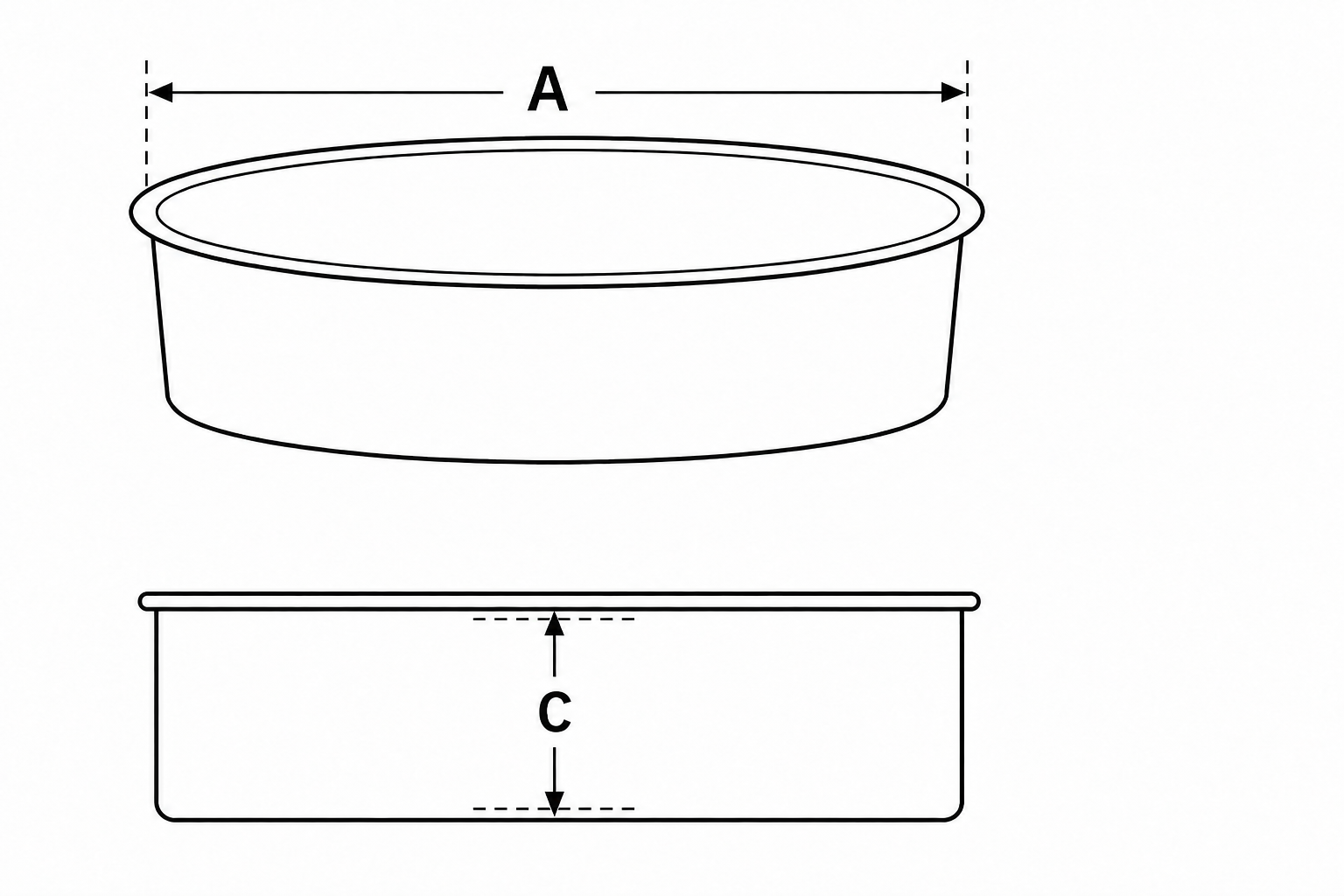
- A - Diameter.
- C - Depth.
Sloping sides
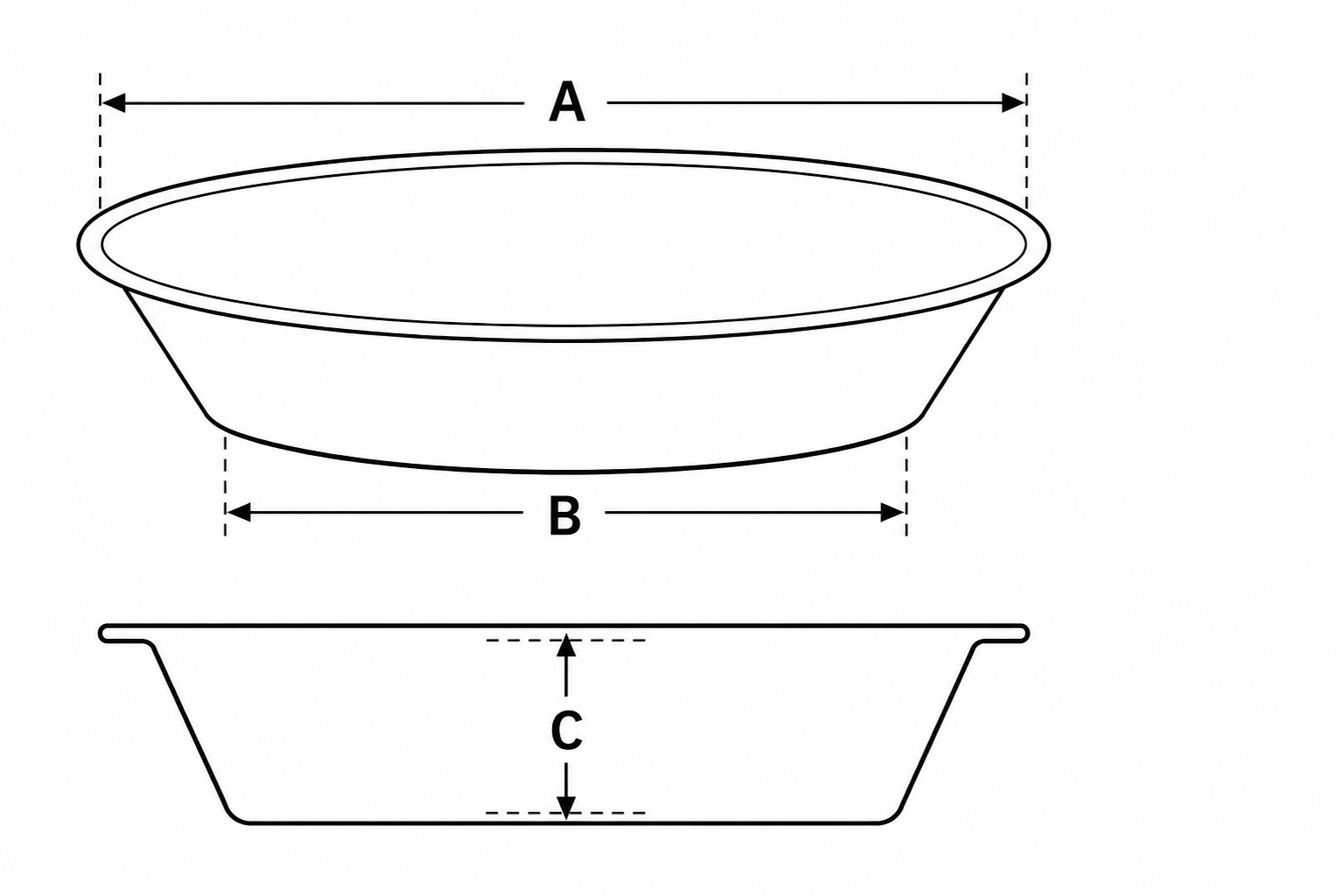
- A- Top diameter.
- B - Base diameter.
- C - Depth
Square dish
Straight sides
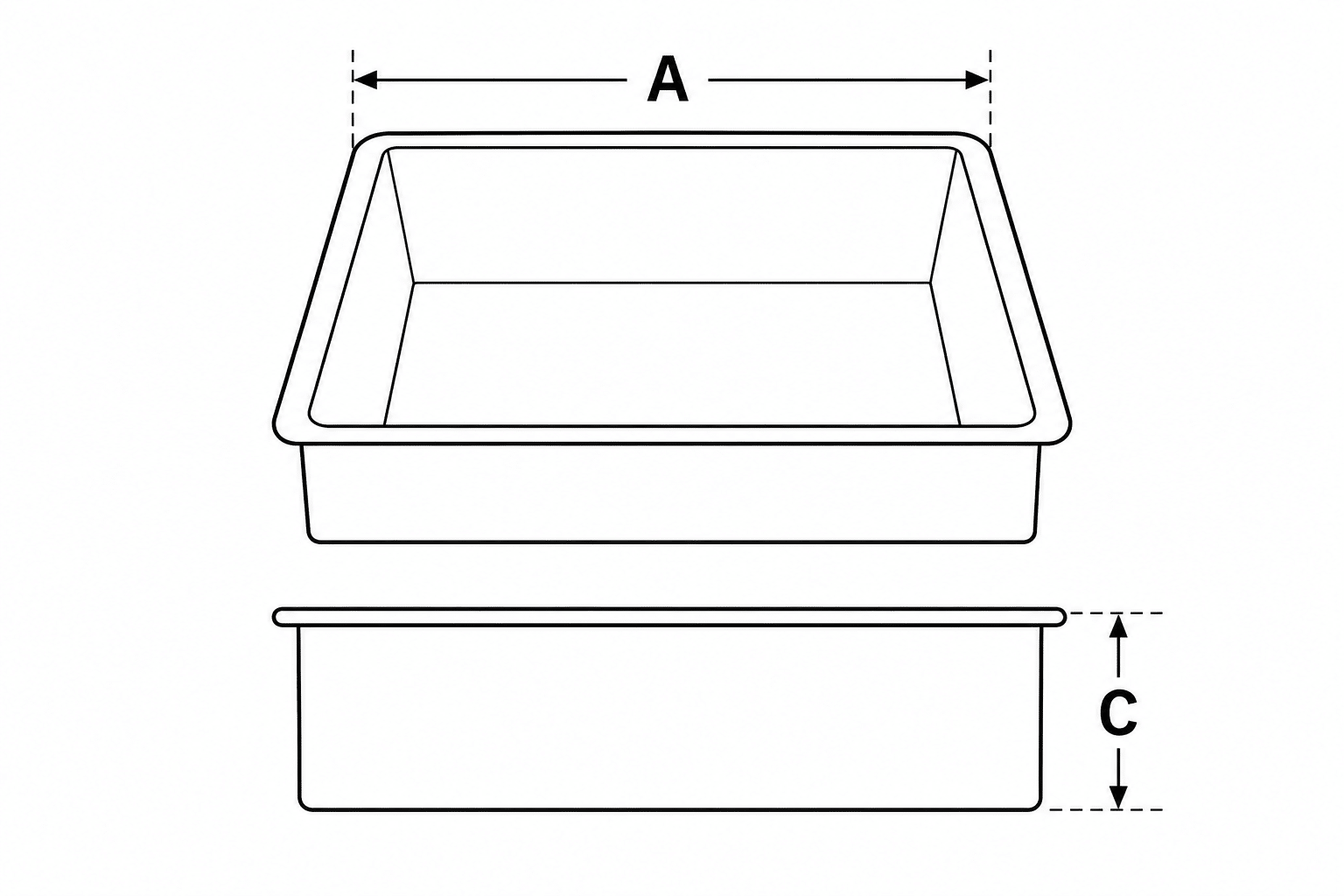
- A - Side.
- C - Depth.
Sloping sides
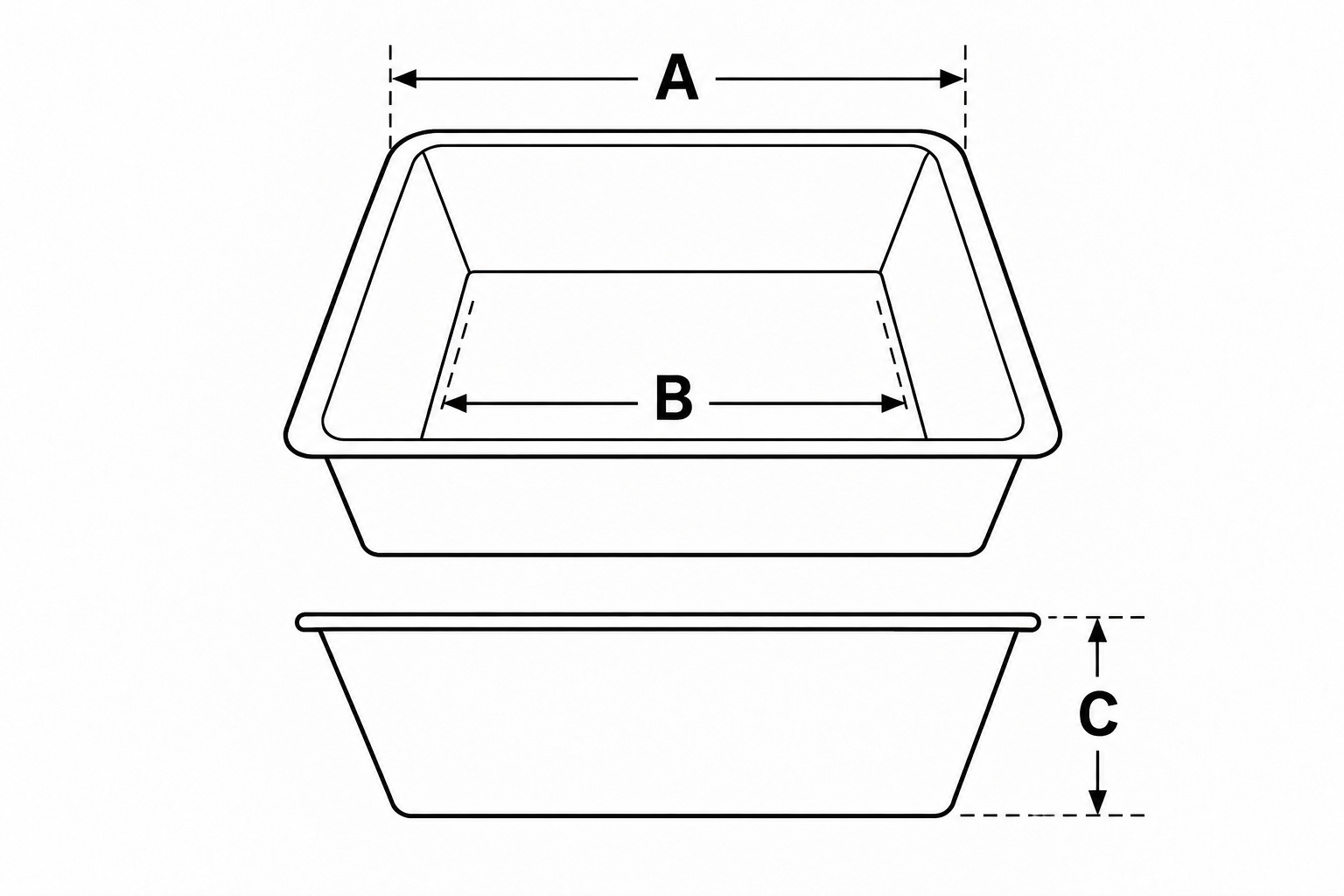
- A- Top side.
- B - Base side.
- C - Depth.
Rectangular dish
Straight sides
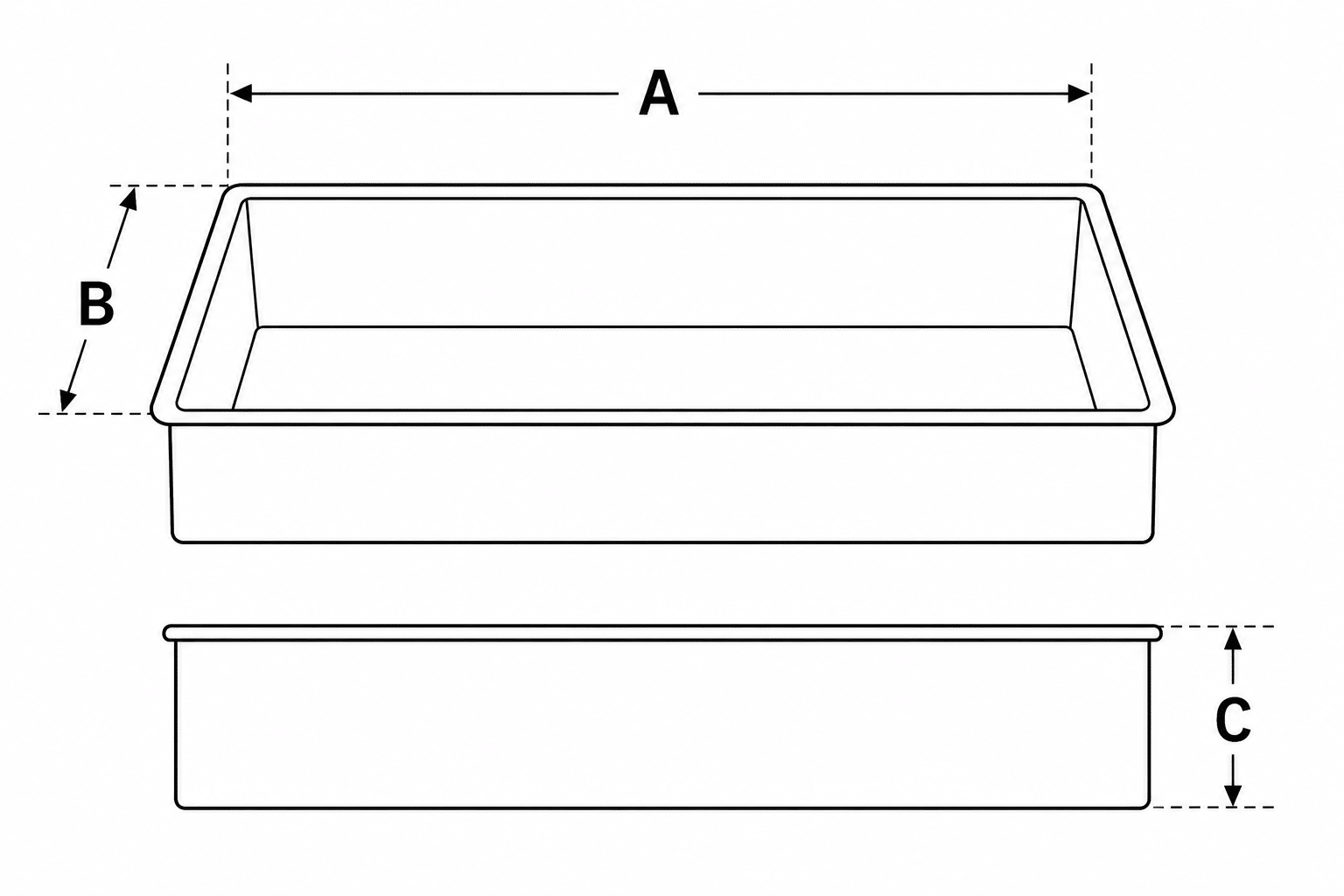
- A - Length.
- B - Width.
- C - Depth.
Sloping sides
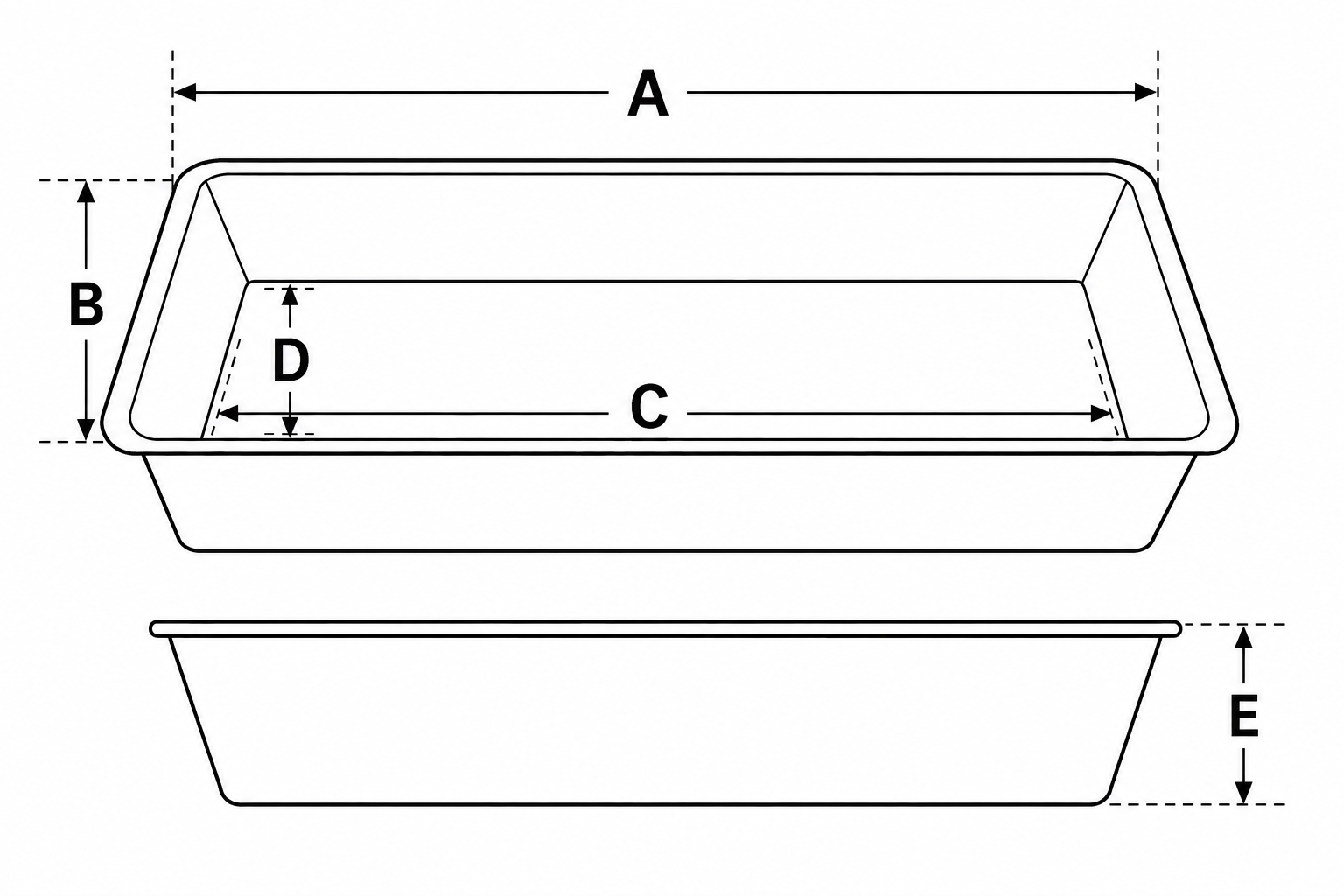
- A- Top length.
- B - Top width.
- C - Base length.
- D - Base width.
- E - Depth.
Assumptions used in the pastry calculator
No pastry calculator can give an exact result for everyone, simply because we all roll pastry to slightly different thicknesses, and pie dishes come in an enormous variety of shapes and sizes. To make the calculation as useful as possible, I've based it on a few practical assumptions which I've listed below.
- Working allowance: The calculations are based on real-world pastry tests and include sufficient pastry for normal rolling and trimming, with a little extra for sealing or fluting the edges where necessary. There is no additional percentage added for wastage.
- Rounding: The calculated amount of flour is always rounded up to the next 10 grams, so you won't be asked to measure out awkward quantities such as 183 grams. The amount of fat is then calculated as half the rounded flour quantity.
- Dish measurements: The calculator uses the measurements you enter to calculate the surface area of your dish. You don't need millimetre-perfect measurements; measuring to the nearest quarter inch or quarter centimetre is sufficiently accurate.
- Shortcrust pastry: The calculator is intended for basic shortcrust pastry made using the traditional 2:1 ratio of flour to fat. It isn't intended for puff, rough puff, choux, or other types of pastry.
- Liquid: Egg and/or water is treated as the liquid used to bind the pastry and isn't included when calculating how much pastry you need. The calculator does, however, provide a suggested amount of liquid as a starting point. Add it gradually, as the exact amount required will vary.
- Cup measurements: Cup measurements are based on a standard 240 ml US cup. If you use a 250 ml metric cup, you'll make slightly more pastry, but that's not a problem - any small amount left over can be popped into the freezer for another day.
The shortcrust pastry ratio - 2:1 or 3:2:1?
You may have come across two different ratios for making shortcrust pastry. The traditional 2:1 ratio refers to two parts flour to one part fat by weight. So, for example, 200 grams of flour would be combined with 100 grams of fat, with enough liquid added to bring the pastry together.
You may also see shortcrust described using a 3:2:1 ratio. This normally refers to three parts flour, two parts fat and one part liquid, again measured by weight. This produces a richer pastry containing proportionally more fat than the basic 2:1 version.
I've based this calculator on the 2:1 flour-to-fat ratio because it's the ratio I use for my basic shortcrust pastry, and it gives a sturdy, versatile pastry that's suitable for lining pie dishes, making tarts and covering pies. The amount of liquid can vary depending on the flour and fat you use and whether you use water, egg, or a combination of the two, so I've treated the liquid separately rather than building it into the pastry ratio.
How much liquid does shortcrust pastry need?
Unlike flour and fat, there isn't one exact amount of liquid that you need to make shortcrust pastry. The amount can vary depending on the flour you use, the type of fat, whether you include egg, and even how dry the flour happens to be.
As a useful starting point, I allow approximately 1 tablespoon (15 ml) of liquid for every ounce (28 g) of fat. The calculator uses this as a guide to suggest how much liquid you are likely to need.
The liquid can be cold water, beaten egg, or a combination of the two. If you use egg, count it as part of the suggested liquid rather than adding it in addition to the water.
Don't add all the liquid at once. Add it gradually, mixing lightly, and stop as soon as the pastry comes together into a soft dough. It should hold together when gently pressed, but shouldn't feel wet or sticky. You may find that you need a little more or a little less than the amount suggested by the calculator.
How does the shortcrust pastry calculator actually work?
The calculator doesn't simply match your dish to a standard pie size. It uses the measurements you enter to calculate the surface area of the pastry needed to cover your particular dish.
For a straight-sided dish, this means calculating the area of the base and adding the area of the sides. For a sloping-sided dish, the calculation also takes into account the difference between the measurements at the top and bottom of the dish, together with its depth. If you select a pastry lid, the area of the top of the dish is included too.
Once the total pastry area has been calculated, the calculator converts this into the amount of flour needed using a factor that I arrived at through real-life pastry testing. This includes a practical working allowance for rolling, trimming and handling the pastry, rather than calculating only the exact area of the dish.
The flour is then rounded up to the nearest 10 grams, and the amount of fat is calculated using the traditional 2:1 ratio of flour to fat by weight. The calculator also provides a suggested amount of liquid, based on approximately 1 tablespoon (15 ml) of liquid for every ounce (28 g) of fat.
The final quantities of flour and fat are displayed in grams, ounces and US cups. These are simply different ways of expressing the same calculated quantities and don't affect the underlying calculation.
FAQ
Yes. The calculator works out the quantity of pastry needed from the size and shape of your dish, so you can use the calculated flour and fat quantities as the basis for sweet shortcrust pastry too. If your recipe includes sugar, add it according to the recipe you are using.
No. The calculator has been developed and tested specifically for shortcrust pastry. Puff and rough puff pastry have different flour to fat proportions and behave differently when rolled, so the calculated quantities may not be suitable.
The calculator includes a practical working allowance for rolling, trimming and handling the pastry. How much you have left will also depend on how thinly you roll it and how closely you trim around your dish. I'd rather have a small amount left over than run short halfway through lining a pie dish.
Yes. Wrap leftover pastry well or place it in a freezer bag and freeze it for another day. Small pieces can be added to the freezer until you have enough to combine into another pastry crust. Defrost the pastry in the refrigerator before using it.
The calculated quantity is deliberately rounded upwards so that you aren't left short because of an awkwardly precise measurement. The difference is small, but it gives you a more practical quantity to weigh in the kitchen.
Different flours absorb different amounts of liquid, and the amount needed can also vary depending on the fat you use and whether you include egg. Add the suggested liquid gradually and stop when the dough holds together when gently pressed without feeling wet or sticky.
Yes. Select the lid-only option, and the calculator will use the dimensions of the top of your dish to work out how much pastry you need. For a small dish, the calculated quantity may be quite small, and you may find it easier to make a slightly larger batch because very small quantities of pastry can be awkward to mix and roll.
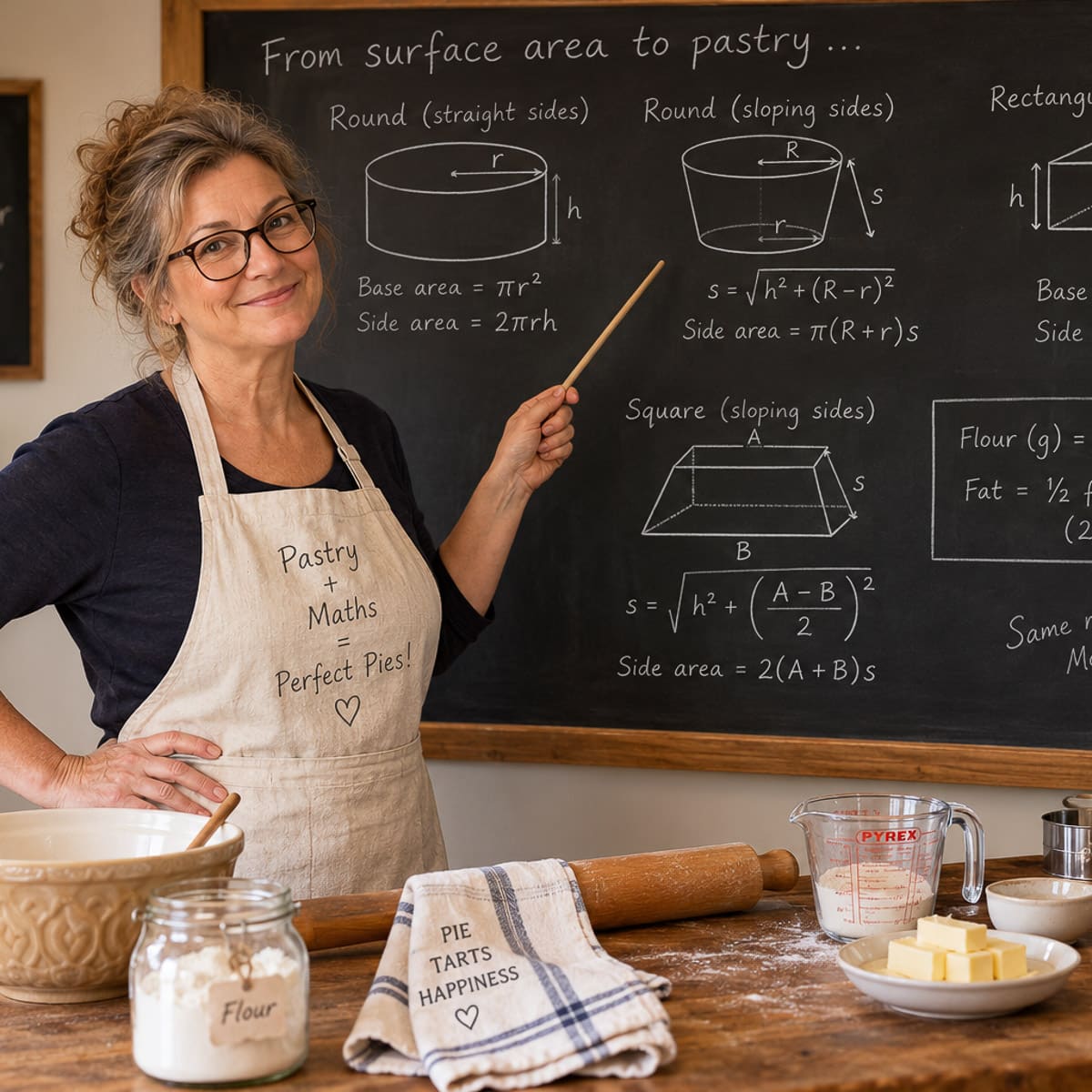
For anyone interested in the maths ...
Feel free to skip this section if you don't want to know the technical details behind the calculator 😁
You don't need to understand the maths behind the calculator to use it, but if you're curious about how the quantities are worked out, here's what happens behind the scenes.
The first step is to calculate the surface area of the dish that will be covered with pastry. The calculation varies according to the shape of the dish and whether the sides are straight or sloping. If you're making a covered pie, the area of the lid is added too. If you only need a lid, only the area of the top of the dish is used.
Round dishes
For a straight-sided round dish, the base is simply a circle:
- Base area = π × radius²
- The sides form what is effectively a rectangle wrapped around the dish, so:
- Side area = circumference × depth; or
- Side area = 2 × π × radius × depth
For a sloping-sided round dish, the top and base have different diameters, so the sides form part of a cone rather than a cylinder.
- The calculator first works out the sloping distance from the base to the top edge using the depth of the dish and the difference between the top and base radii:
- Sloping height = √(depth² + (top radius − base radius)²)
- It then calculates the area of the sloping sides:
- Side area = π × (top radius + base radius) × sloping height
- If a lid is required, its area is calculated from the top radius:
- Lid area = π × top radius²
Square dishes
A straight-sided square dish is even simpler:
- Base area = side × side, and
- Side area = 4 × side × depth
- For a sloping-sided square dish, the calculator first works out the true sloping height of the sides:
- Sloping height = √(depth² + ((top side − base side) ÷ 2)²)
- It then uses this to calculate the area of the four sloping sides:
- Side area = 2 × (top side + base side) × sloping height
- If you're adding a lid:
- Lid area = top side × top side
Rectangular dishes
- For a straight-sided rectangular dish - Base area = length × width
- The four sides are calculated from the length, width and depth - Side area = 2 × depth × (length + width)
For a sloping-sided rectangular dish, things get slightly more interesting because the length and width can both change between the base and the top. The calculator works out the sloping height in each direction separately and uses those measurements to calculate the area of all four sides.
- Long-side sloping height = √(depth² + ((top width − base width) ÷ 2)²)
- Short-side sloping height = √(depth² + ((top length − base length) ÷ 2)²)
It then calculates the total area of the four sloping sides:
- Side area = (top length + base length) × long-side sloping height + (top width + base width) × short-side sloping height
For a covered pie:
- Lid area = top length × top width
From surface area to pastry
Once the total surface area has been calculated, the calculator applies a conversion factor based on my real-life pastry testing to determine how much flour is needed. Based on my tests, the calculator uses approximately 1.875 grams of flour per square inch of pastry-covered surface area.
This conversion factor includes a practical amount of extra pastry for rolling, trimming and handling, so the calculation isn't based on covering the exact surface area of the dish with no pastry to spare.
The calculated amount of flour is then rounded up to the nearest 10 grams, and the fat is calculated at half the weight of the rounded flour, giving the 2:1 flour-to-fat ratio used throughout this calculator.
Now it's your turn!
I hope this calculator takes some of the guesswork out of working out how much shortcrust pastry you need. If you use it, I'd really love to hear how you get on - particularly what size and shape of dish you used and whether you found the quantity of pastry about right. Your feedback will help me fine-tune the calculator as more people put it to the test.
And if you're looking for something to fill your freshly lined pie dish, why not try some of these:



Did you make this recipe? Let me know!