
(or how to convert grams to cups (or back again) without losing your mind)
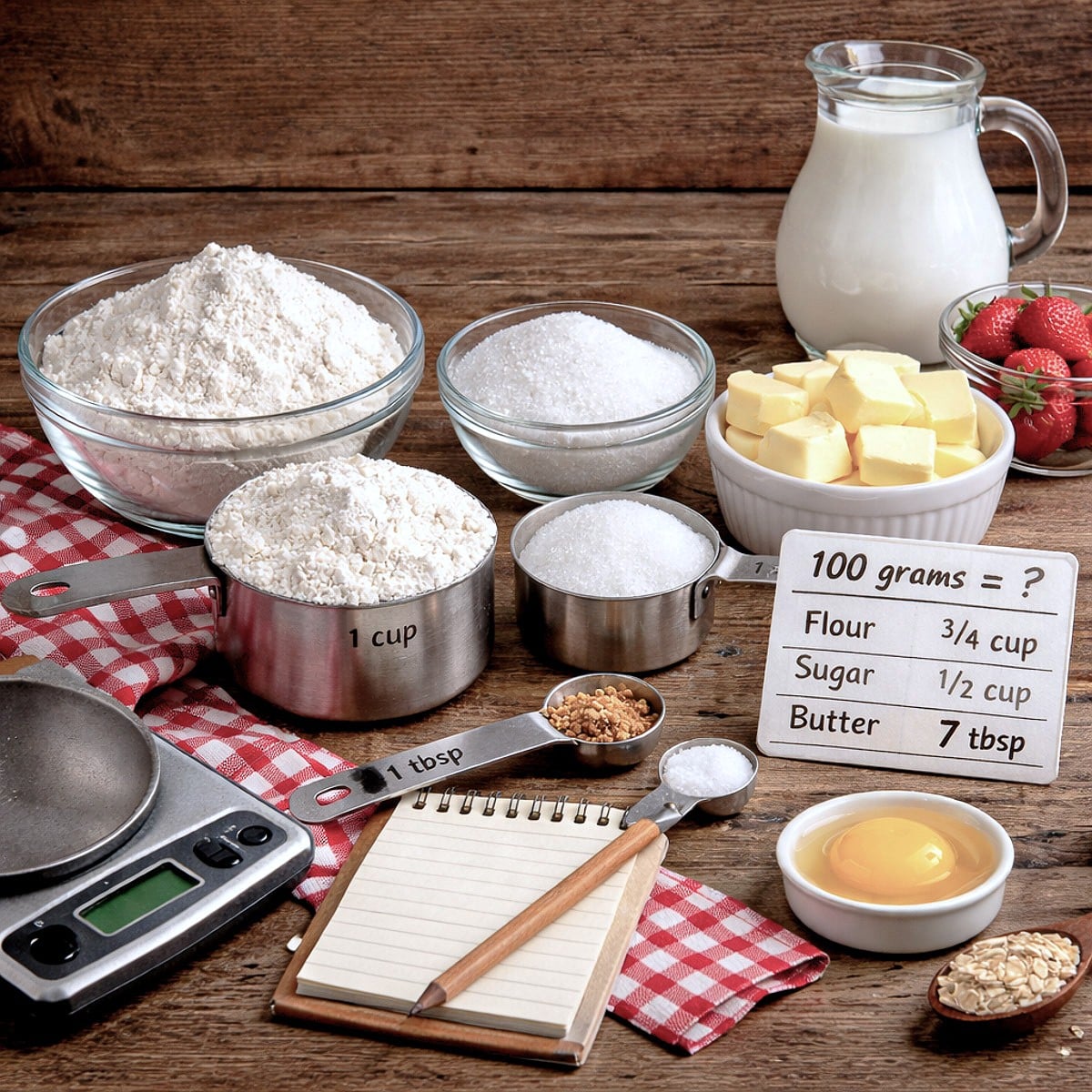
How many grams are in a cup? It all depends on what you put in it. As standard US measuring cup of flour weighs much less than a US cup of sugar, even though both fill the same cup. Select your ingredient in the calculator below to convert grams to cups, or cups back to grams. You can also convert ounces, mililitres and tablespoons.
Grams measure weight, while cups measure volume - which is why converting between them depends on the ingredients you are using.
Jump to:
- How this calculator works
- Grams to cups calculator
- Convert oven temperatures
- Why weighing ingredients is more accurate than using cups
- My recommended way to fill a measuring cup
- Different types of measuring cups
- Let's talk about measuring spoons
- Useful conversions
- Convert US cups to tablespoons
- Convert grams to ounces
- Convert US cups to millilitres and metric cups
- Other common kitchen measurements
- FAQ
- Save for reference
- Baking recipes
How this calculator works
In a nutshell, this is how the grams to cups calculator works (and why you should use it):
- Uses ingredient-specific weights.
- Converts a measure to 6 different units instantaneously.
- Accounts for different-sized cups - both US (240 ml) and metric (250 ml).
- Converts between weight and volume accurately and consistently.
- Rounds results to the closest sensible amount.
Grams to cups calculator
Choose an ingredient, enter an amount and select the unit shown in your recipe. US cups are 240 ml; metric cups are 250 ml.
- Grams
- US cups
- Ounces
- Metric cups
- Millilitres
- Tablespoons
Cup results are estimates based on the listed ingredient's weight per 240 ml US cup. Spoon and cup filling methods can change the actual weight.
Are you trying to convert grams to cups and getting different answers every time? I'm not surprised! Conversions can be fiddly, especially when different ingredients all weigh differently.
That's why I put together this simple grams to cups conversion calculator, which enables you to convert ingredients between grams, cups, ounces, millilitres and tablespoons at the push of a button.
Just select your ingredient from the drop-down list, then pop in the amount and unit you want to convert and click on the 'CONVERT' button. You'll get an accurate result in seconds - no maths, no guessing and no ruined bakes.
It's one of those pages that's worth bookmarking, because you'll probably come across plenty of recipes that you'd like to make but aren't quite sure how to convert from one unit to another!
Convert oven temperatures
If you need to convert oven temperatures, I've got you covered too. Just select the unit (Celsius, Fahrenheit or Gas), enter the temperature, and this calculator will convert it to the other units for you.
- Celsius
- Fahrenheit
- Approximate Gas Mark
These are conventional oven settings, not fan oven settings. Gas Mark equivalents are approximate; follow the temperature and oven type given in your recipe.
Why weighing ingredients is more accurate than using cups
The most accurate way to measure ingredients, especially when baking, is to use a set of kitchen scales. Weighing ingredients in grams (or ounces) removes the guesswork that comes with measuring by volume, as cups can vary depending on how ingredients are packed, scooped or sifted.
Here's a simple example using flour. Both of these cups below are filled with flour, yet the difference in weight is clear.
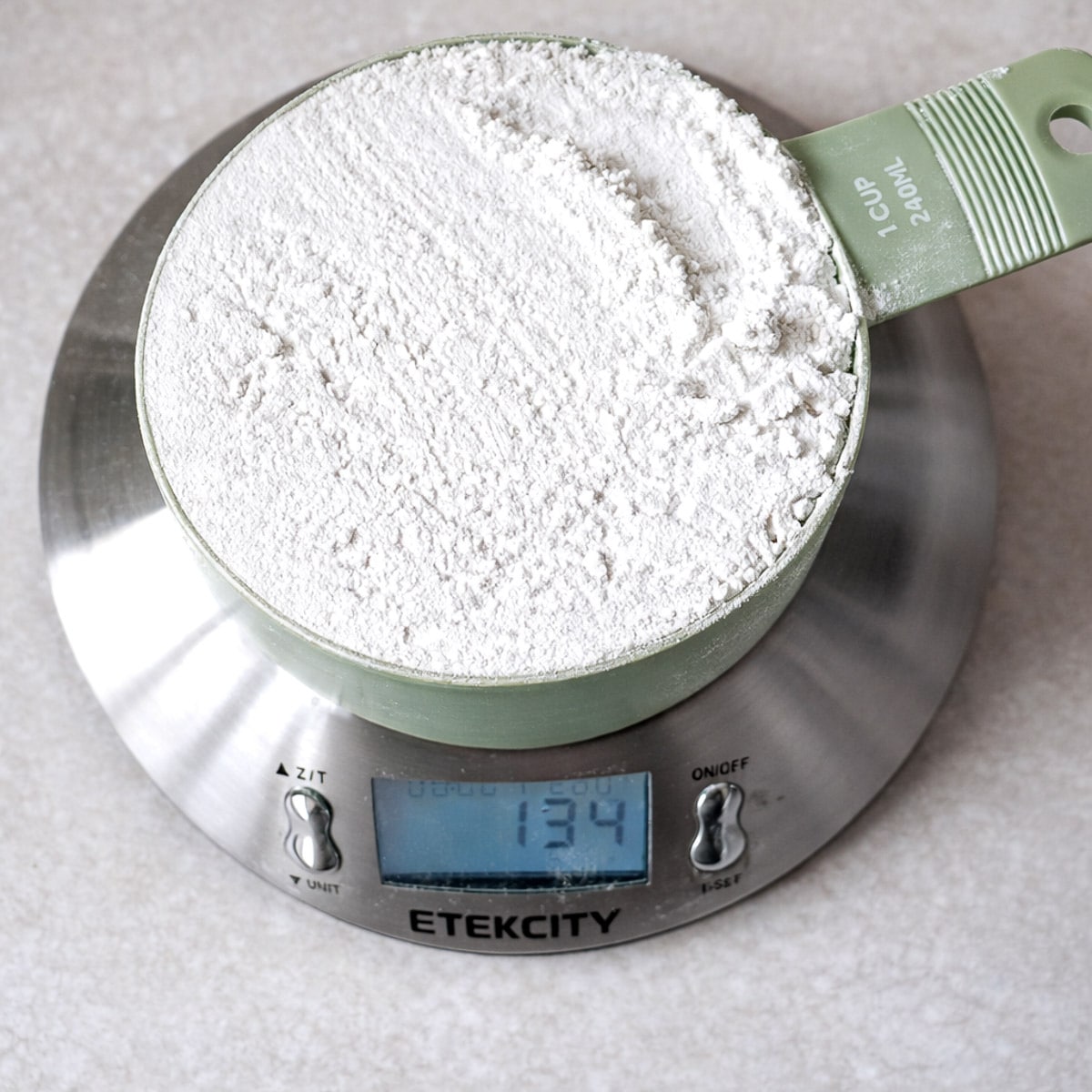
This cup of flour was filled by scooping tablespoons of flour into the cup, then levelling it with the back of a knife. Weight = 134 grams.
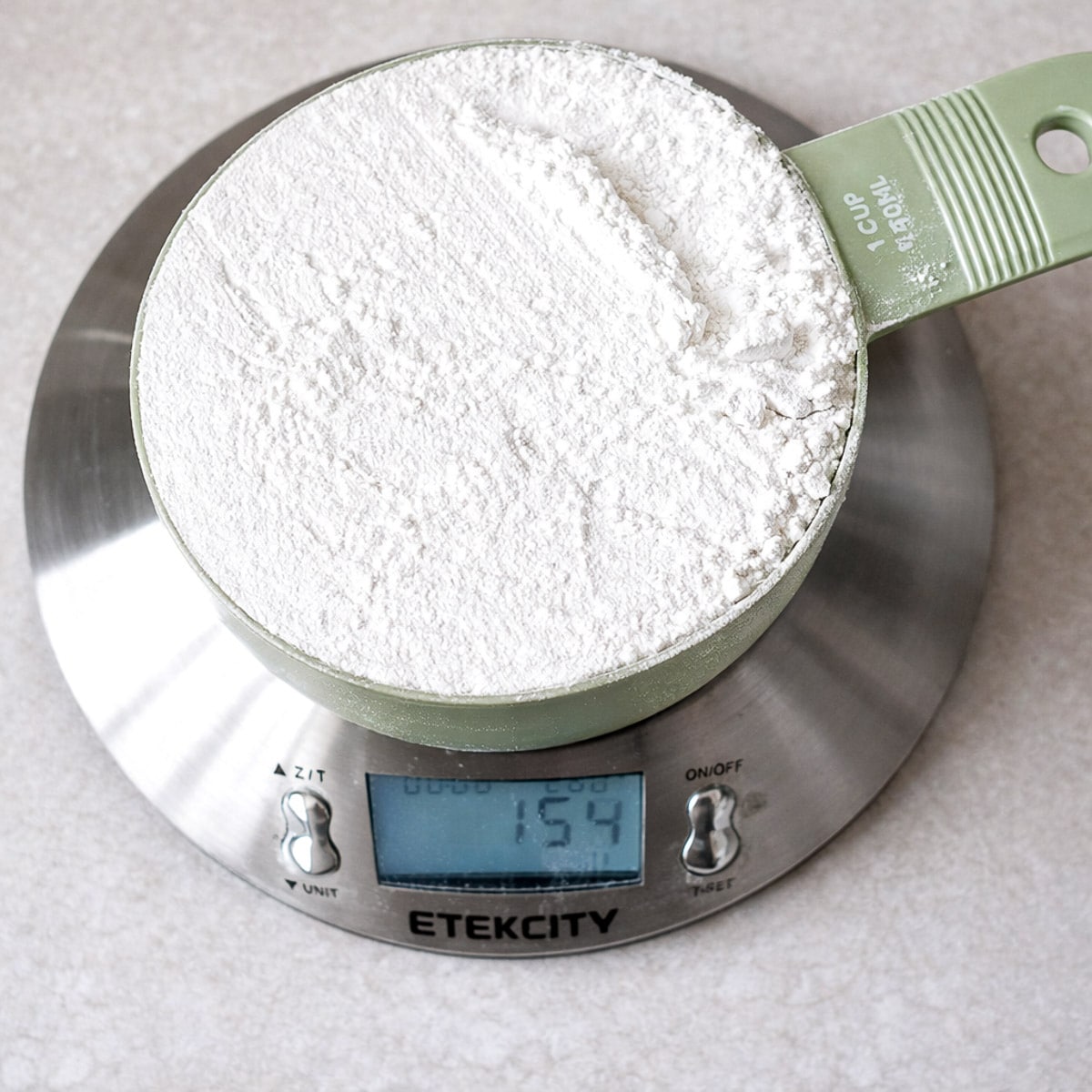
The same measuring cup was filled by scooping the flour directly out of the container before levelling it with the back of a knife. Weight = 154 grams.
That's a 20-gram difference using the same cup and the same ingredient. The variation can become even greater if the flour is sifted before measuring.
After plenty of testing (and a fair bit of trial and error), I standardised on 1 cup of flour weighing 140 grams, or 16 tablespoons. This standardisation balances accuracy with pratticality and reflects how most home bakers actually measure flour. It is the value used as the basis for the conversion calculator on this page.
I tend to develop a recipe using weight as the measurement (grams and/or ounces), and once I'm happy that it works, I convert the measurements to cups (using my calculator, of course 😁) and make it again to check. Only once I'm happy everything is working as it should, does the recipe get published.
My recommended way to fill a measuring cup
Based on the points above, this is the most consistent and accurate way to measure dry ingredients using cups.
- Use a tablespoon to transfer flour from the container into your measuring cup.
- Continue spooning in the flour until it is slightly heaped above the rim.
- Avoid pressing or compacting the flour as you fill the cup.
- Use the back of a knife (or another flat edge) to level the flour flush with the rim.
This method is more reliable than scooping directly from the container, which could possibly compact the flour, resulting in using more than the recipe intends.
Different types of measuring cups
You may or may not be aware, but there are two slightly different types of measuring cups commonly used in recipes:
- US (or US customary) cups - hold 240ml of liquid and are the standard in the United States.
- Metric cups- hold 250 ml of liquid and are used in most other parts of the world.
Because a large proportion of my readers are based in the US, all my recipes are based on the US customary (240 ml) cup. However, the conversion calculator on this page can be used to convert ingredients using both US and metric cup measurements.
That said, the difference between the two cup sizes is relatively small. As long as you use the same size cup throughout the entire recipe, the proportions will remain the same, and your recipe will still work.
For the most reliable results, particularly in baking, using a kitchen scale to weigh your ingredients is always the best option. It takes the guesswork out of measuring and helps ensure your bakes turn out as intended.
Let's talk about measuring spoons
- Measuring spoons are one of the most useful tools in the kitchen, especially for smaller quantities where accuracy still matters, but tiny variations won't ruin a recipe.
- The important thing to bear in mind is that unless a recipe states otherwise, all teaspoon and tablespoon measurements should be level and not heaped.
- I use a double-sided set of measuring spoons - one end is a standard round shape, while the other is long and narrow. The narrow end is particularly handy for scooping spices straight out of small jars without tipping half the contents over the counter.
- Being double-sided, these spoons work well for both dry and wet ingredients, so there's no need to swap tools halfway through the recipe.
- Because a spoon holds a much smaller amount than a cup, being slightly over or under isn't usually critical. A small difference in a teaspoon or tablespoon won't affect the final result anywhere near as much as a heavy-handed cup of flour would.
- For everyday cooking and baking, measuring spoons are a reliable and convenient option, especially when paired with a kitchen scale for larger amounts.
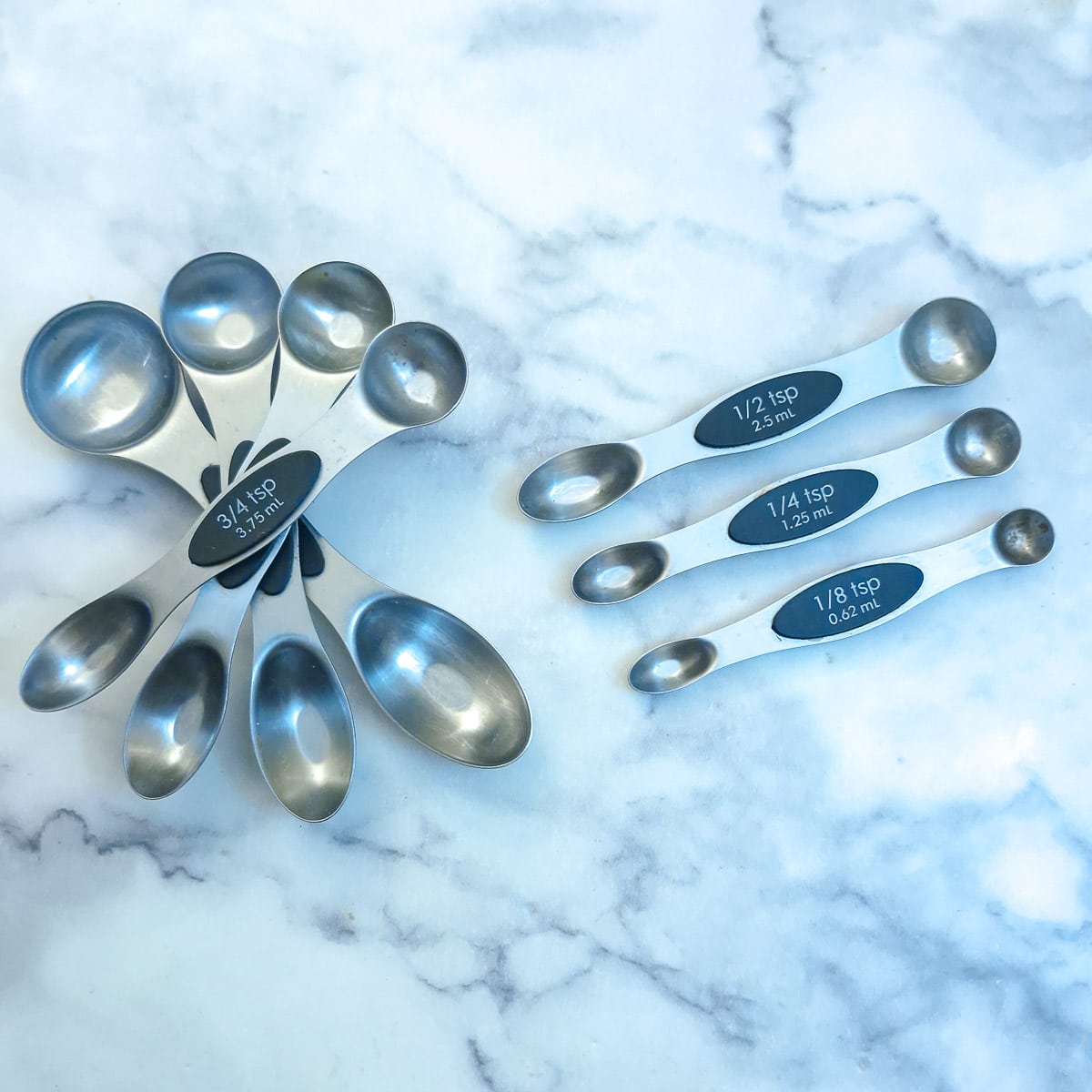
You can follow this link to Amazon to see the magnetic measuring spoons I use.
Useful conversions
Here are a few standard conversions that you may find useful. These are general reference values and work best when you stick to the same measuring system throughout a recipe.
Convert US cups to tablespoons
1 tablespoon = 1/16th cup - there are 16 tablespoons in one cup
| US Cups | Tablespoons |
|---|---|
| 1 cup | 16 tablespoons |
| ⅞ cup | 14 tablespoon |
| ¾ cup | 12 tablespoons |
| ⅝ cup | 10 tablespoons |
| ½ cup | 8 tablespoons |
| ⅜ cup | 6 tablespoons |
| ¼ cup | 4 tablespoons |
| ⅛ cup | 2 tablespoons |
| 1/16 cup | 1 tablespoon |
Convert grams to ounces
If you are converting weight to weight, the ingredient doesn't matter. There are 28.35 grams in one ounce, so to convert between grams and ounces, you can either multiply the ounces by 28.35 or divide the grams by 28.35 The calculator automatically provides the ounce or gram conversion alongside the cup conversion.
These amounts are rounded to the most sensible result for everyday cooking and baking:
| Grams | Ounces |
|---|---|
| 10 grams | ¼ oz |
| 15 grams | ½ oz |
| 20 grams | ¾ oz |
| 30 grams | 1 oz |
| 40 grams | 1½ oz |
| 50 grams | 1¾ oz |
| 75 grams | 2¾ oz |
| 100 grams | 3½ oz |
| 150 grams | 5¼ oz |
| 200 grams | 7 oz |
| 225 grams | 8 oz |
Convert US cups to millilitres and metric cups
There is not much difference between a US cup and a metric cup, just slightly more than half a tablespoon. As long as you use the same type of cup throughout a recipe, the proportions will remain the same
| US Cup | Metric Cup | Millilitres |
|---|---|---|
| ¼ cup | 0.24 | 60 ml |
| ⅓ cup | 0.32 | 80 ml |
| ½ cup | 0.47 | 120 ml |
| ⅔ cup | 0.63 | 160 ml |
| ¾ cup | 0.71 | 180 ml |
| 1 cup | 0.95 | 240 ml |
| 1.06 cups | 1 | 250 ml |
Quick reference
- 1 US cup =16 tablespoons = 240 ml = 0.95 metric cups
- 1 metric cup = 16.6 tablespoons = 250 ml = 1.06 US cups
Other common kitchen measurements
| Measurement | Equivalent |
|---|---|
| 1 teaspoon | 5 ml |
| 1 tablespoon | 3 teaspoons |
| 1 tablespoon | 15 ml |
| 1 ounce | 28.35 grams |
| 1 gram | 0.035 oz |
| 1 pound | 16 ounces |
| 2 cups | 1 pint |
| 1 stick butter (US) | 113 grams (or 4 ounces) |
FAQ
This is because grams measure weight and cups measure volume. Different ingredients have different densities, so the weight of a cup of flour is different to the weight of a cup of sugar or butter. That's why accurate conversions need to be ingredient-specific.
For baking, where a recipe very often requires precise measurements, measuring in grams (or ounces) is always more accurate. Cups can vary depending on how ingredients are scooped, packed or sifted, while grams (or ounces) give consistent results every time.
A cup of flour can vary depending on how it's measured. For the purposes of this calculator, 1 cup of flour is standardised at 140 grams, which reflects an average between common measuring methods.
Yes, the calculator allows you to convert ingredients using both US (240 ml) and metric (250 ml) cups, so you can choose the option that matches your measuring cups.
Yes. You can use the calculator to measure thin liquids such as water or milk; 240 ml of water or milk is the equivalent of 240 grams. However, thicker liquids such as honey or syrup will weigh more than water as they have a higher density.
If a recipe gives a liquid in millilitres, a measuring jug is usually the easiest choice.
This often depends on the origin of the recipe. European recipes tend to use grams and millilitres while American recipes commonly use cups and tablespoons. Converting between them ensures you can follow any recipe accurately.
You can use this calculator to convert between any combination of grams, ounces, US cups, metric cups, tablespoons and millilitres.
It may use a different cup size, a different ingredient weight, or another way of filling the cup. Check which cup the recipe uses and, when available, follow the recipe author's gram weight. For my recipes, the figures in this calculator match my own conversions.
Yes, to measure part of a cup (either US or Metric) enter 0.5 for half or 0.25 for a quarter. The calculator accepts decimal numbers.
Save for reference
If you cook or bake regularly, don't forget to bookmark this page. It's one of those tools you'll come back to again and again! You can also save this page to Pinterest by clicking on the image below.
Alternatively, you can save it by clicking on the floating heart icon at the right-hand side of the screen.
Baking recipes
While you're here, you might like to take a look at some of my baking recipes. (They all have the ingredients listed in both cups and grams 😁)
If you'd like to get in touch, you can email me at [email protected]. I'd love to hear from you. And don't forget to subscribe to my mailing list so you can grab yourself a copy of my FREE COOKBOOK!
If you'd like to continue browsing, just click on this link to all my recipes.

Tatum Krofta says
Hallo. beeindruckende Arbeit. Ich habe das nicht erwartet. Das ist eine beeindruckende Geschichte. Danke!
Portion Control Plate says
Sie können definitiv Ihre Enthusiasmus in Gemälden sehen, die Sie schreiben. Die Arena hofft auf mehr leidenschaftliche Schriftsteller wie Sie, die keine Angst haben zu sagen, was sie glauben. Immer gehe nach deinem Herzen.
VJ says
I translated this - You can definitely see your enthusiasm in paintings you write. The Arena hopes for more passionate writers like you who are not afraid to say what they believe. Always go according to your heart. ???
Evangeline Shallow says
Wow! Thank you! I permanently needed to write on my site something like that. Can I include a fragment of your post to my site?
VJ says
It depends what the fragment is that you would like to include. If it is just the tables listing the different weights and ingredients then that is public domain and provided you re-format it (ie don't copy and paste) you are welcome to use that information. On the other hand I own the intellectual property to the actual calculator (and the code behind it) so I'm afraid you can't take that and publish it on your site. However you are welcome to add a link from your site to my calculator page. Hope this helps - get in touch if you'd like to discuss further.
Brooks Sweitzer says
Hello.This post was really interesting, especially since I was browsing for thoughts on this issue last couple of days.
Suzanne Kyle says
I am exciting to use your recipes
Jenny says
Hi VJ,
Thanks so much for your very helpful site. I was born in Rhodesia, now Zimbabwe of course, and lived for quite a few years in South Africa. I loved South African food with all the wonderful influences from such a variety of cultural people although I could never manage a true Durban curry without a fire extinguisher to hand! Congratulations on your wonderful site with so many great explanations. I have learned a lot!
Thanks so much! Jenny
VJ says
Thank you for your lovely comment. I am always so pleased to hear that people enjoy my recipes! I'm with you on the fiery Durban curry - I'm a bit of a wimp where that is concerned - I always tone down the chilli when I make it!
Jamie says
Hello,
Thank you for the converter, Can you add things like table salt, mustard seeds, cumin seeds and fenugreek seeds to the converter? Not sure if they are readily available to you. But would really help a lot.
Thank you
VJ says
Good idea - thank you. Give me a day or two to see what I can do. Linseeds are already up there so mustard seeds would be similar. I'll take a look at the others for you.
Annalee says
Thank you very much for this calculator. Every other one I found looked like it had been created by someone who never cooked. I really appreciate you taking the time to create an accurate converter that I can trust! your recipes look wonderful as well and I will definitely be back to read more!
VJ says
Thank you for your lovely comment. If you think of anything I can do that would improve the calculator please let me know 🙂
Hope you enjoy the recipes!
VJ x
Krisry says
Will you please add onions to the list
VJ says
Hi Krisry - It would be difficult to add things like onions / carrots / potatoes etc because the amount in the cup would vary depending on how large the pieces are cut. The smaller the onion is cut, the more pieces will fit into a cup, and the heavier the cup would be. However, what I will do is add a chart showing the approximate weights and measures for onions and other common vegetables. Just give me a day or so and I'll publish it.
VJ x