
Keep the heat down in the kitchen by using your slow cooker to make this fall-apart slow braised blade steak in a delicious red wine and onion gravy, lightly flavoured with creamed horseradish and Dijon mustard.
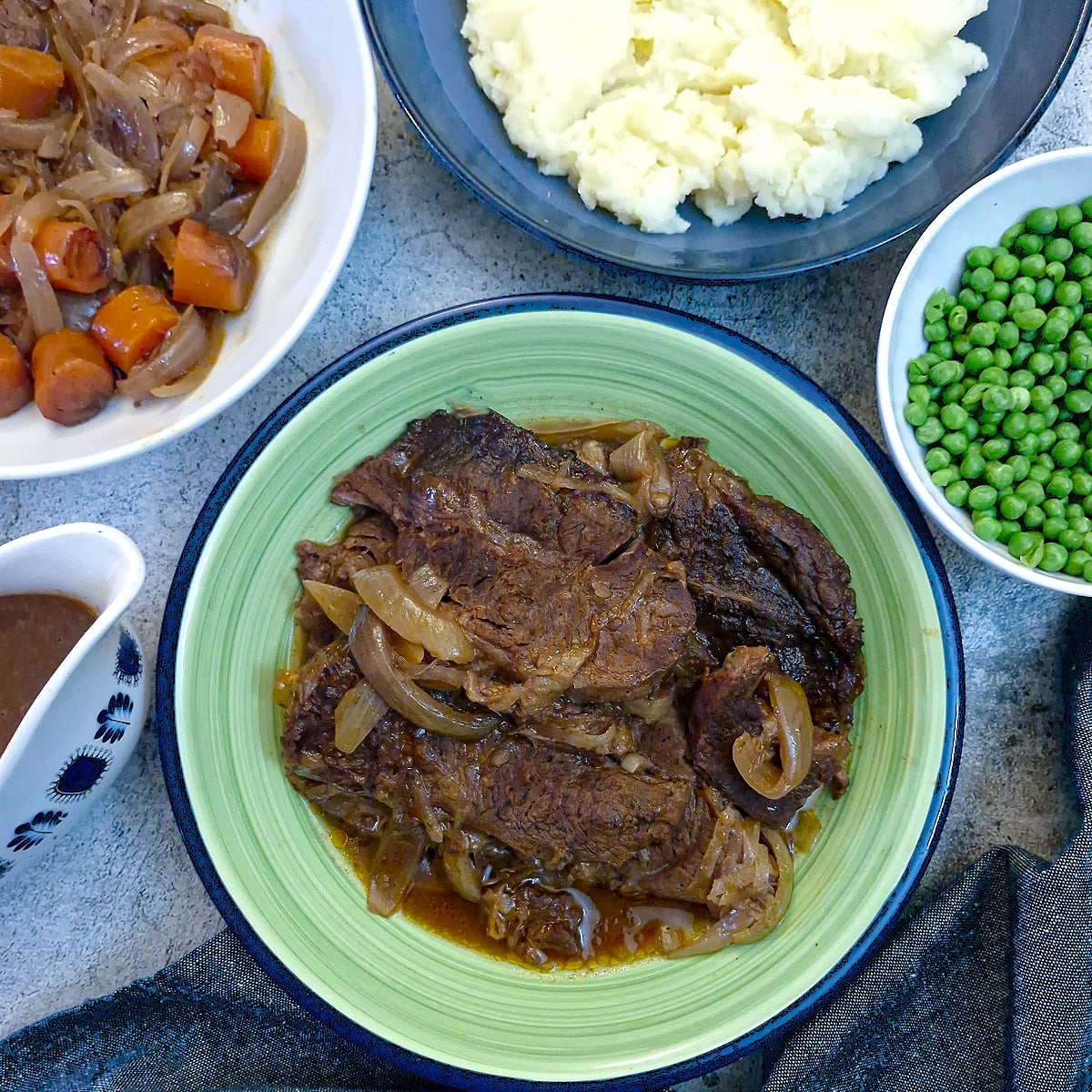
This recipe uses a cut of beef known as Featherblade steak or Blade steak. It is part of the beef chuck (shoulder) and is ideal for cooking in a slow cooker.
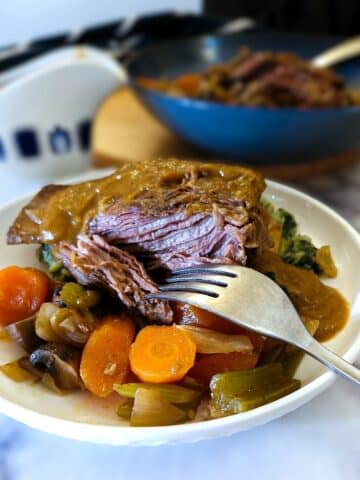
After hours of gentle braising in the slow cooker, a tough cut of beef becomes meltingly tender, breaking apart easily with a fork (although if you are careful and use a spatula to help you), you will be able to serve whole pieces of this succulent meat directly from the pan.
The sweet onions soften and all but disappear into the cooking liquid, creating a deeply savoury gravy that's infused with the flavours of red wine, beef stock and herbs. A touch of Dijon mustard and creamed horseradish adds just enough warmth to the gravy to enrich it without overwhelming the beef.
Once the ingredients are cooking, the hard work is done, leaving you free to get on with your day while the slow cooker creates a delicious meal of slow-cooked beef and onions. Serve with creamy mashed potatoes and seasonal vegetables, or even add a slice of crusty bread to soak up every last spoonful of the luscious gravy.
I love using the slow cooker, especially in hot weather. It creates easy meals with hardly any effort on your part, doesn't heat up the kitchen and is more economical to run than switching on the oven.
You might also like these other slow cooker beef recipes:
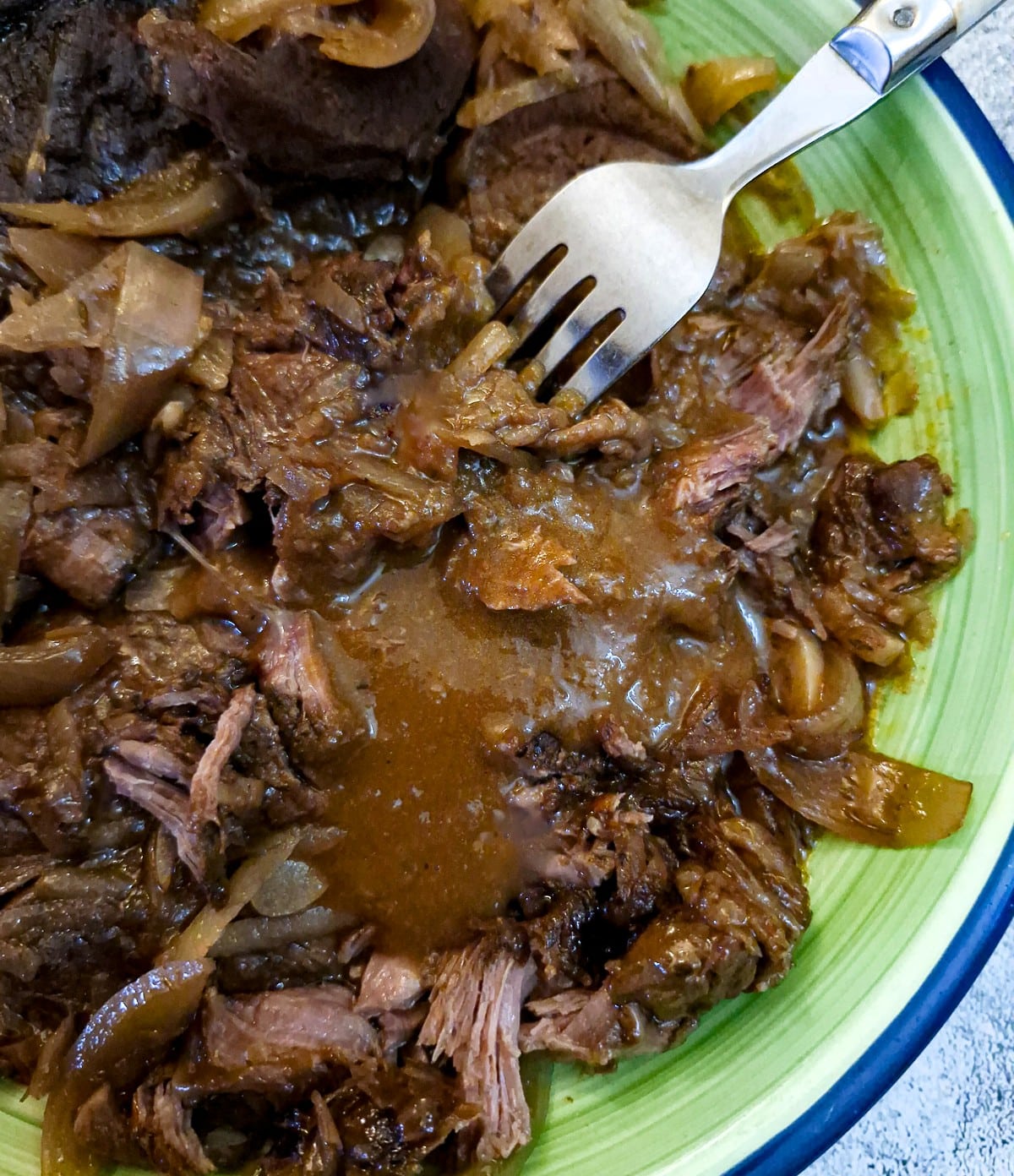
And this is just to show you how easily the meat breaks up with a fork.
Table of Contents
- Slow braised featherblade steak at a glance
- Why you should make this tender braised beef recipe
- Ingredients for beef in red wine and onion gravy
- How to make slow-braised featherblade beef
- Tips for making slow-cooked beef and onions
- Serving suggestions
- Variations
- Equipment
- Storage and freezing
- FAQ
- Save for later
- Related recipes
- The recipe
Slow braised featherblade steak at a glance
- Quick overview of this easy slow-cooker beef recipe: Sear the beef in a hot pan, then arrange it on a bed of onions and carrots in a slow cooker. Pour over a mixture of stock, red wine and seasonings and leave for a few hours while the slow cooker works its magic.
- Main ingredients: Stewing beef, onions, carrots, stock, red wine and various seasonings.
- Prep time: 20 minutes
- Cooking time: 7 to 8 hours on low or 4 to 5 hours on high.
- Yield: Serves 4
- Difficulty: Easy
Why you should make this tender braised beef recipe
- Fall-apart tender beef. Slow cooking transforms an economical cut of stewing beef into a succulent, tender meal. Slow cooking dissolves collagen and connective tissue, leaving the meat soft and juicy.
- Rich red wine and onion gravy. There are a LOT of onions in this recipe, but they break down during the long, slow cooking, creating a rich savoury gravy.
- Minimal hands-on cooking. The beauty of using a slow cooker is that you 'set it and forget it'. You don't even have to stir it as it cooks - unless you want to, of course 😁.
- Keeps the kitchen cool. Perfect for summer days when you don't want the oven running for hours.
- Simple ingredients - big flavours. Just a few everyday pantry ingredients combine to create a dish that is far greater than the sum of its parts.
- Make-ahead and freezer-friendly. The flavours develop even more as the dish stands, making this slow-braised blade steak ideal to make the day before. It also freezes beautifully, so it's perfect for batch cooking and meal prep.
Ingredients for beef in red wine and onion gravy
**This is just an overview to explain why I used a particular ingredient. The complete list of ingredients and the exact measurements are on the printable recipe card at the end of this post.**
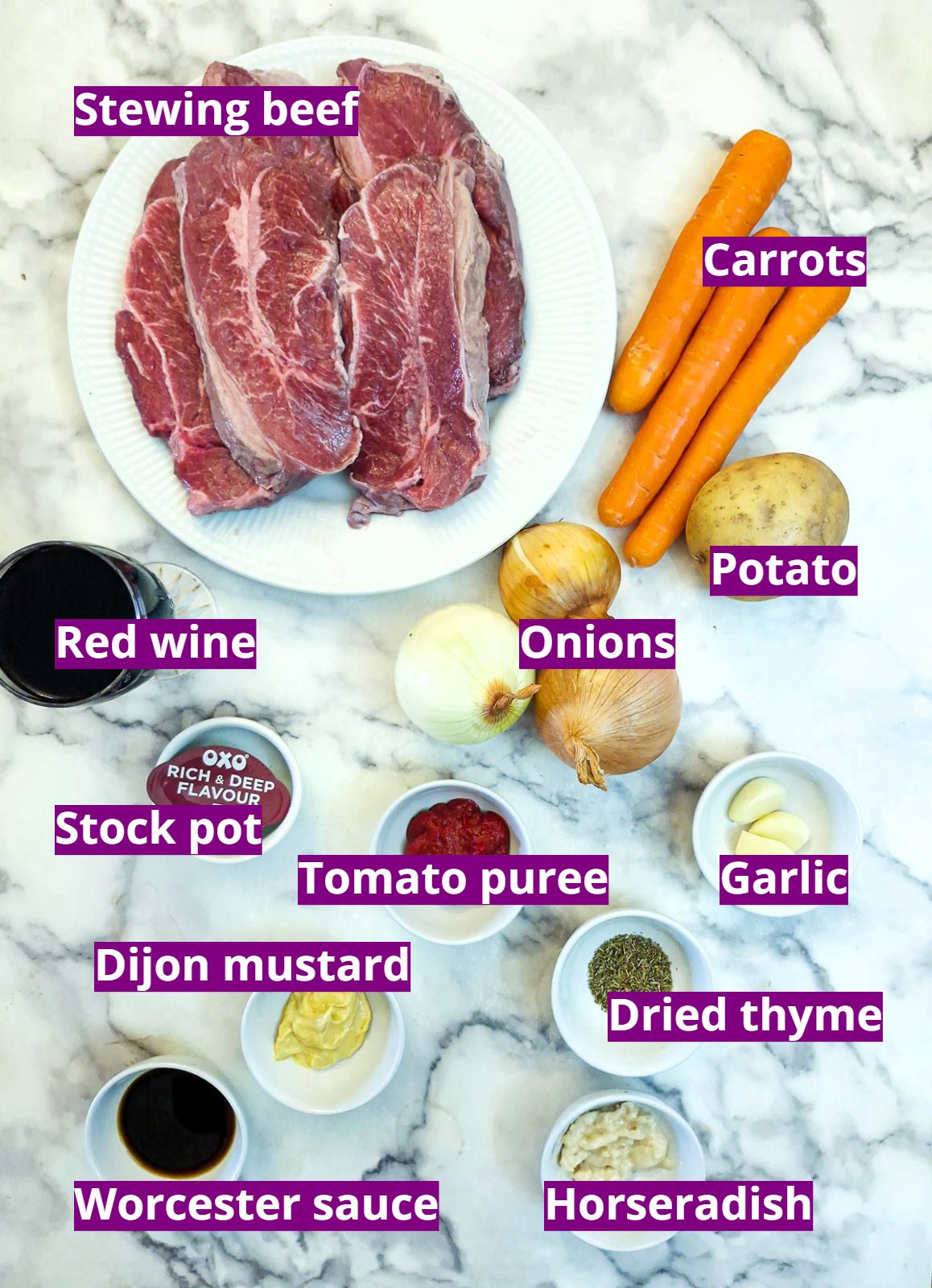
- Stewing beef. I used a cut of beef called 'featherblade', which is part of the shoulder (chuck) or more specifically, the blade muscle. You may also hear it referred to as Blade steak. The name featherblade comes from the distinctive seam of connective tissue that runs through the centre of the muscle. When this muscle is cut into steaks, this seam resembles a feather, hence the name. Both featherblade and flat iron cuts come from the same muscle. Featherblade is cut with the connective tissue still running through the middle, whereas with flat iron, the butcher removes the tough central seam, leaving two pieces of meat. You might like to try this slow cooker flat iron steak recipe too.
- Of course, you don't need to use any fancy cuts of beef; you could use any stewing beef cut you prefer - topside, flank or chuck will all work well.
- Onions. I used white onions (you may call them brown onions). They develop a lovely sweet flavour once they've been cooking for hours. They should be peeled and sliced.
- Carrots. The only vegetables I added to the slow cooker were a few chopped carrots. If you want to add more vegetables and make this more of a stew (or a one-pan meal), then by all means, add different ones. The carrots should be peeled and cut into chunks.
- Potato. The potato is grated and added right at the beginning of the cooking process so that it can break down, leaving its starch to thicken the gravy naturally.
- Stockpot. I used a red-wine-flavoured stockpot, but any beef stockpot would be fine. If you don't have stockpots, use an Oxo cube or similar, or ready-made beef stock.
- Water. This is to dilute the stockpot (or dissolve the Oxo cube). Obviously, if you are using ready-made beef stock, you won't need any additional water.
- Red wine. Use a good full-bodied red wine that you would actually drink. I like to use a Shiraz or Pinotage, but any good red wine would do. The main thing to remember is 'if you wouldn't drink it, don't cook with it'. A bad quality wine won't improve with cooking, and might even spoil your food. Substitute with stock if you don't want to cook with alcohol.
- Salt. This is optional and to your own taste, but I at least like to sprinkle a little salt on the meat before browning it, and depending on how salty the Worcestershire sauce makes the gravy, I might add half a teaspoon of salt to the slow cooker too.
- Sunflower oil. A small amount of oil - just to sear the beef.
Flavourings
- Tomato puree or tomato paste. This is highly concentrated tomatoes, not tomato ketchup.
- Worcestershire sauce. Adds a lovely savoury element. Don't add too much, or you may end up making the gravy too salty. A couple of tablespoons will be fine. If you live in the north of England, you might like to substitute it with Henderson's relish!
- Garlic. A few freshly chopped cloves of garlic. I normally buy a pack of 6 bulbs of garlic at a time, clean them and store the cloves in a plastic bag in the freezer. Whenever I'm cooking with garlic, I just grab as many cloves as I need from the bag. Saves so much time!
- Dried thyme. One of my favourite herbs. Substitute with oregano, mixed herbs or rosemary, or leave it out.
- Creamed horseradish and Dijon mustard. These are optional, but I find a small amount of each added to the gravy makes a world of difference. They add a tangy warmth, and I know it sounds trite, but you miss them if they're not in there.
How to make slow-braised featherblade beef
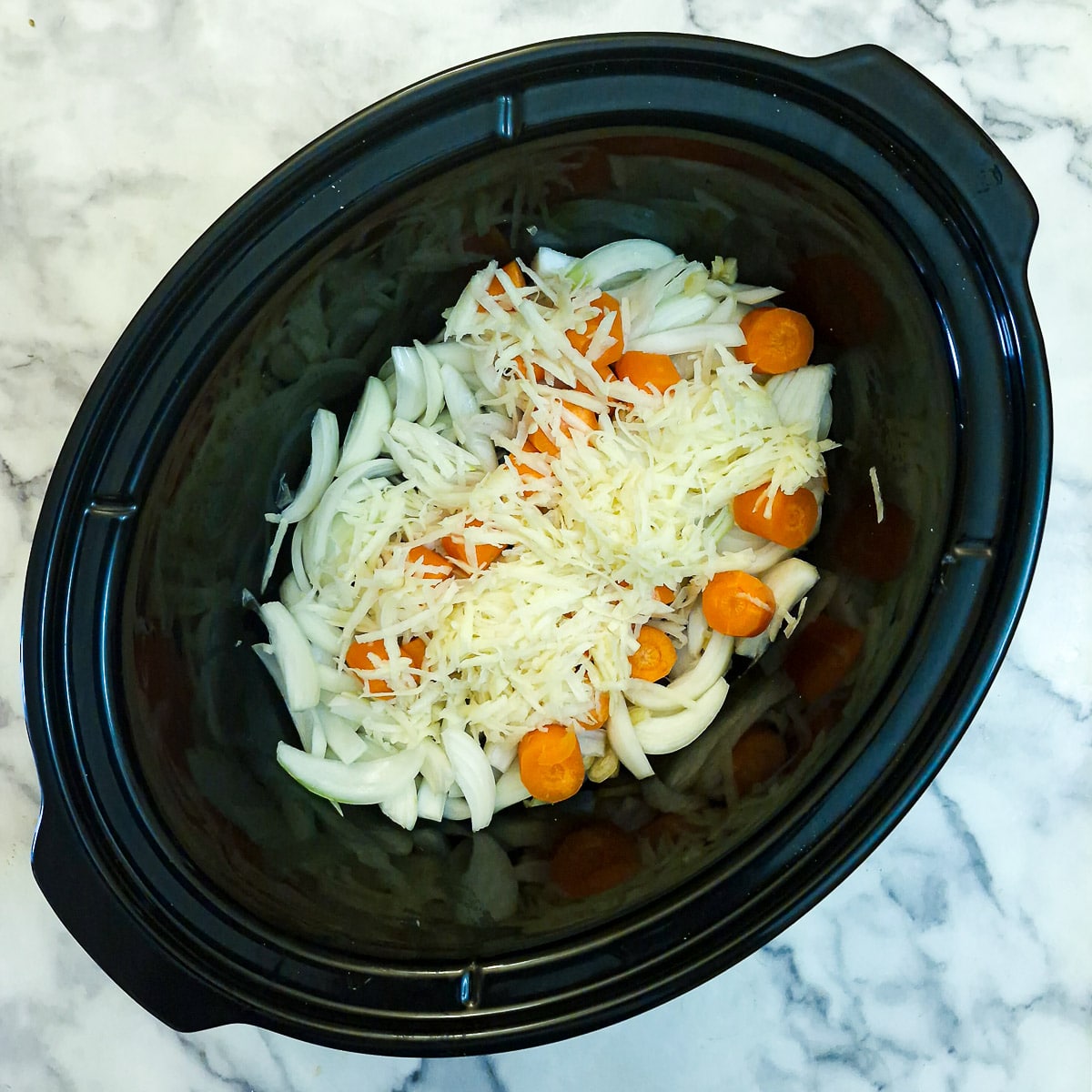
Step 1: Place the sliced onions, chunked carrots, grated potato and finely chopped garlic into the slow cooker.
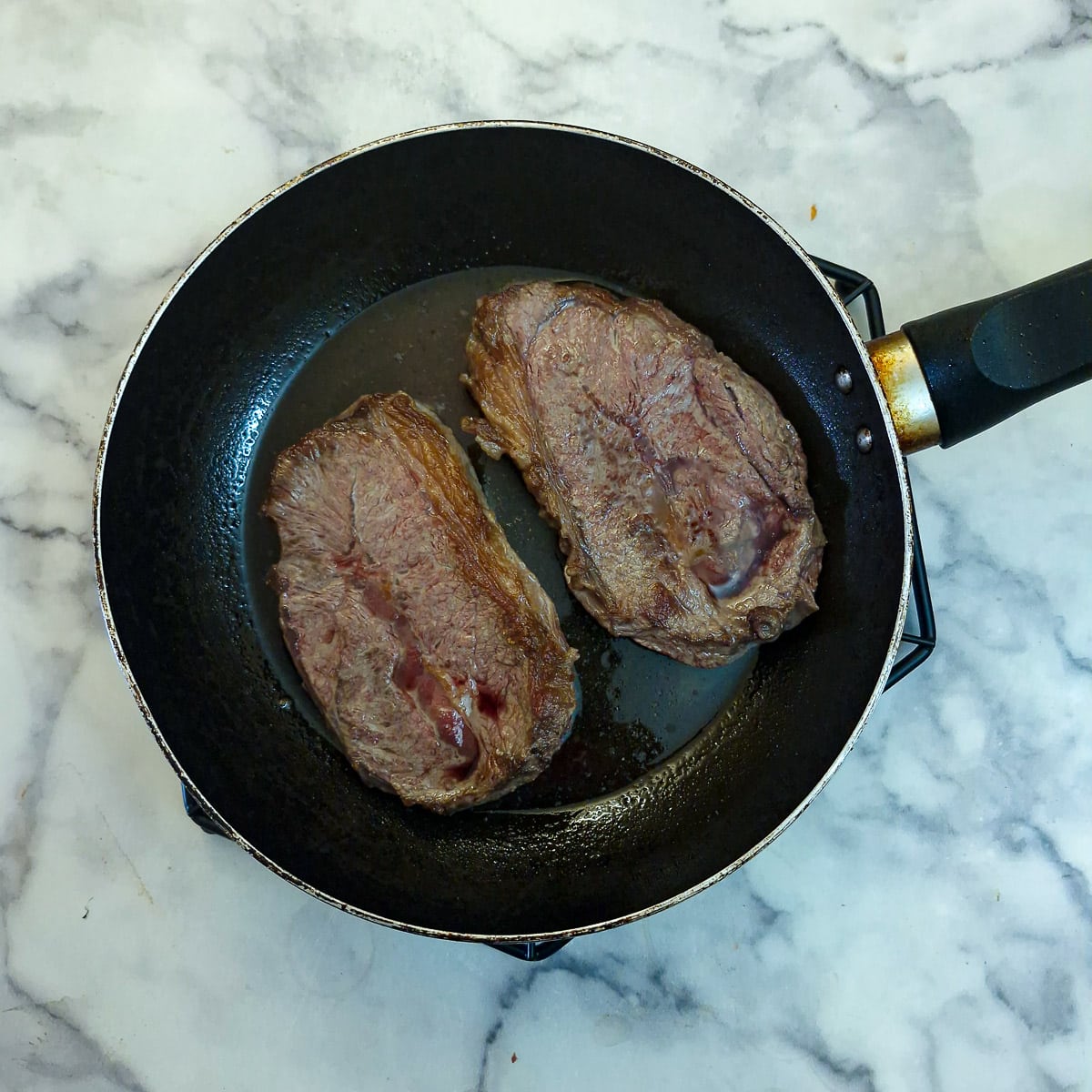
Step 2: Heat a drizzle of cooking oil in a frying pan. Sprinkle the beef lightly with salt and sear it over medium to high heat on both sides. Do this in batches - don't overcrowd the pan.
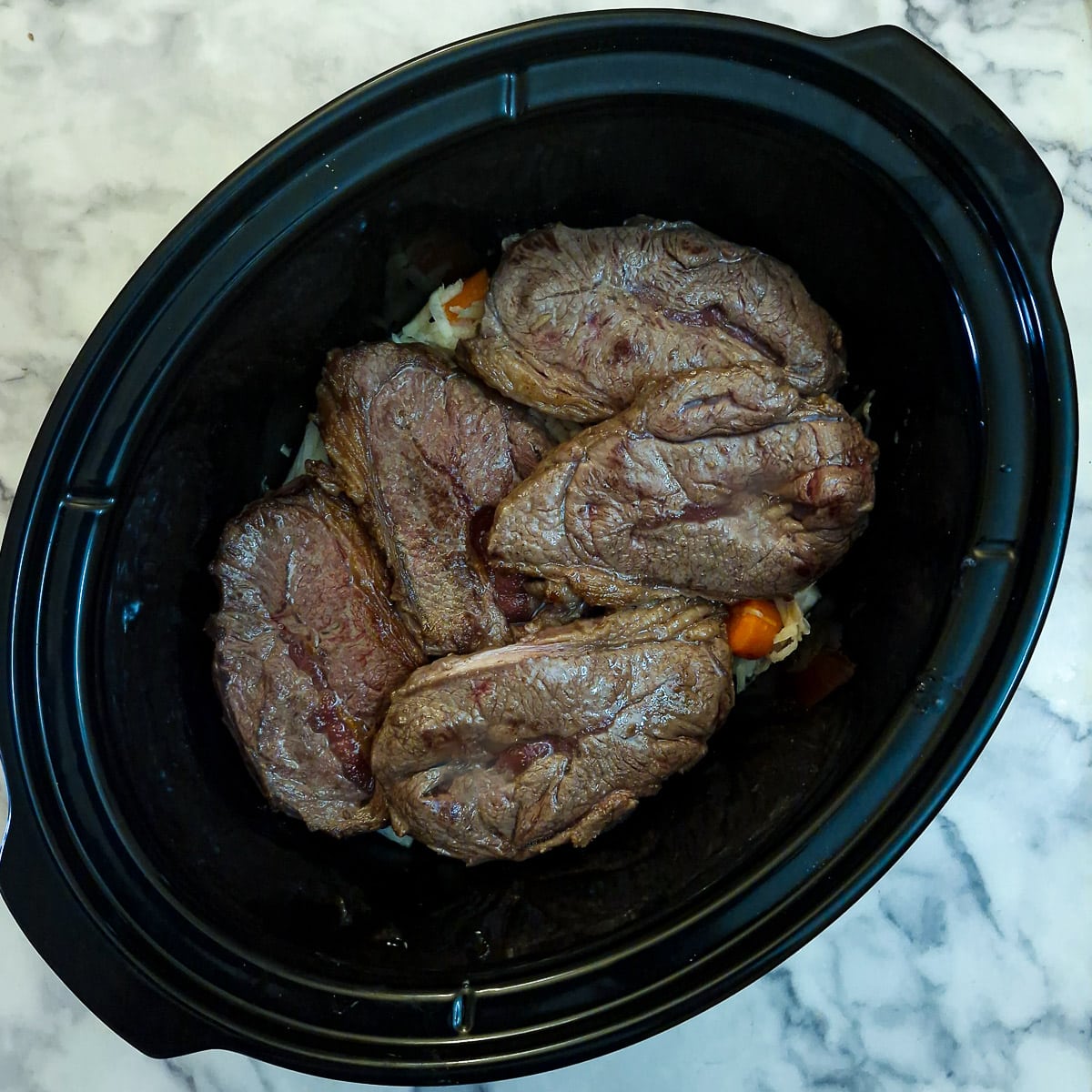
Step 3: Arrange the seared beef on top of the vegetables in the slow cooker.
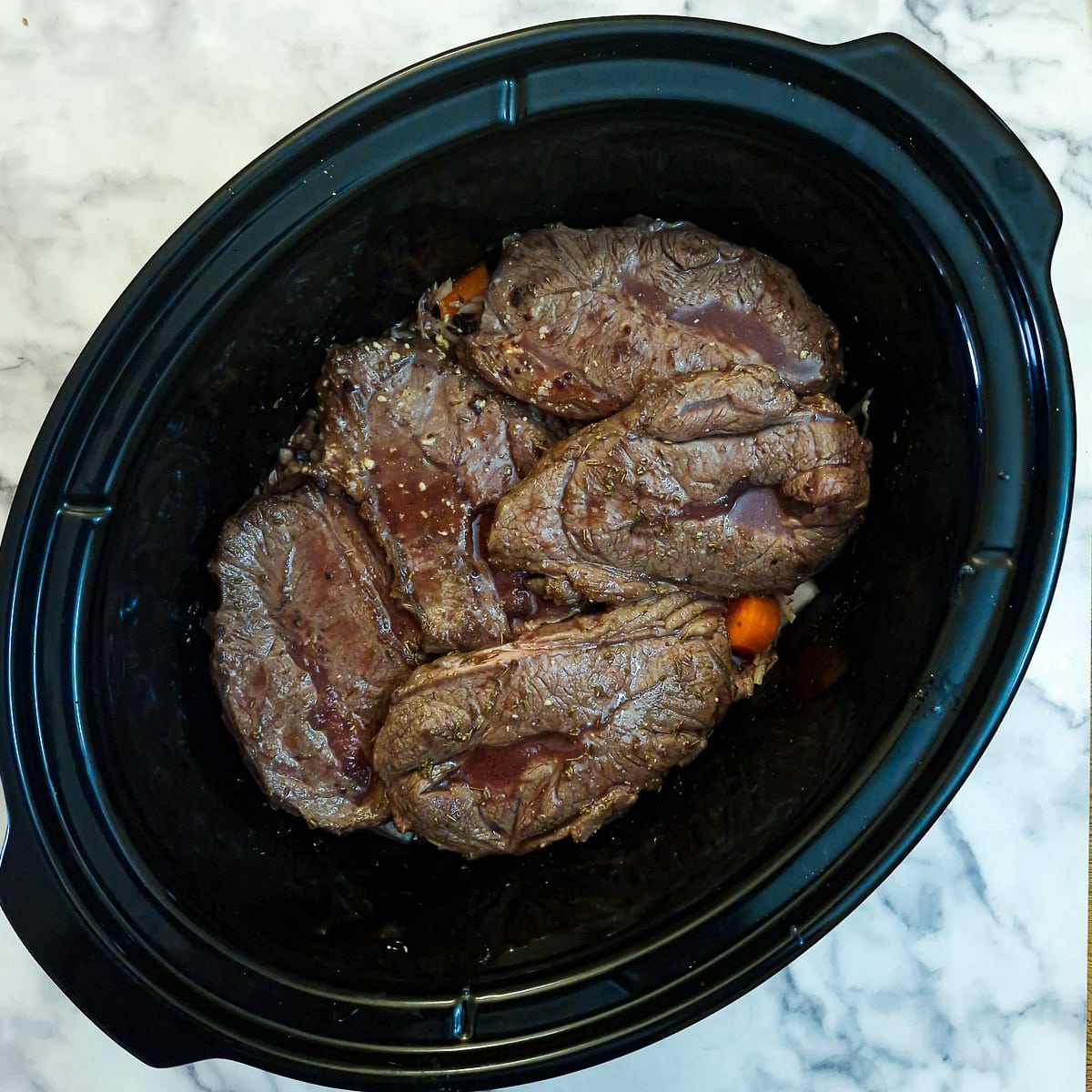
Step 4: Dissolve the stockpot in a large jug in one cup of boiling water, then stir in the red wine, Worcestershire sauce, tomato puree, horseradish, mustard and thyme. Pour it over the meat and vegetables.
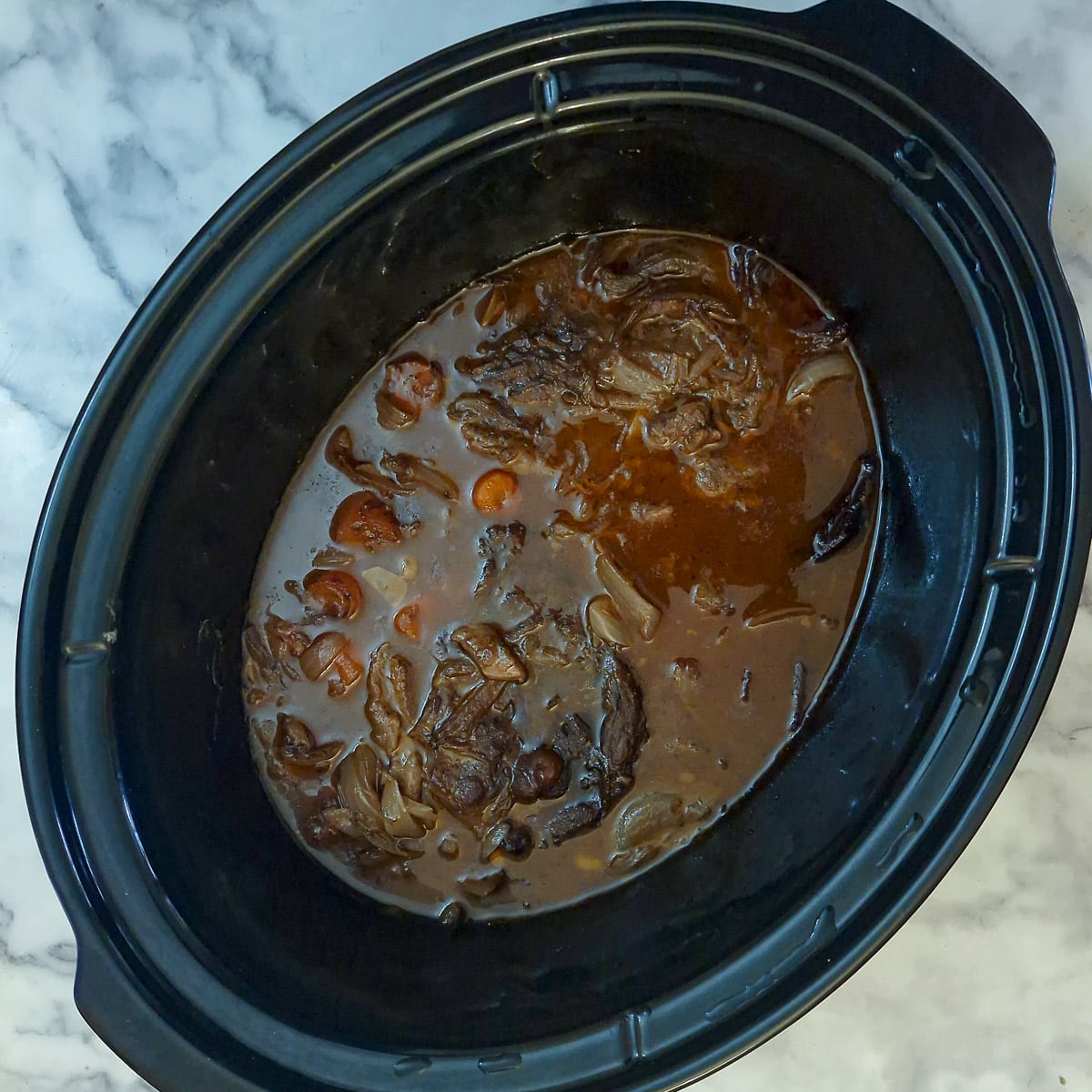
Step 5: Cover the slow cooker with a lid and cook on low for 7 to 8 hours or on high for 4 to 5 hours until the meat is tender.
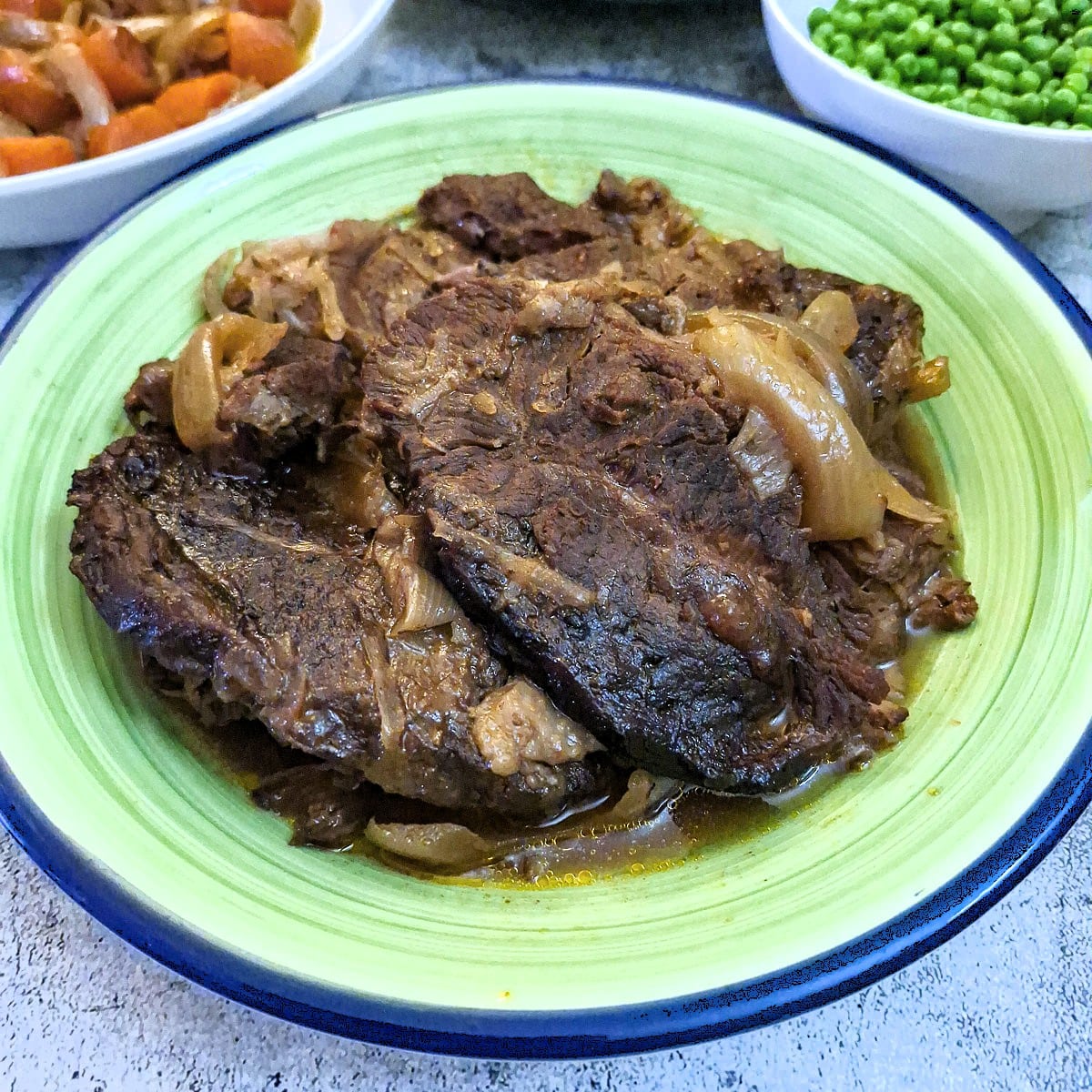
Step 6: Transfer the meat to a serving plate. If you've used large pieces of stewing beef as I have done, use a spatula to help you transfer the meat so it doesn't break up.
- Transfer most of the carrots and onions to a serving dish (they make a delicious side), leaving the cooking juices and about a cup of carrots and onions in the slow cooker.
- Use a stick blender to blend the gravy to a smooth paste and pour it into a gravy boat or small jug.
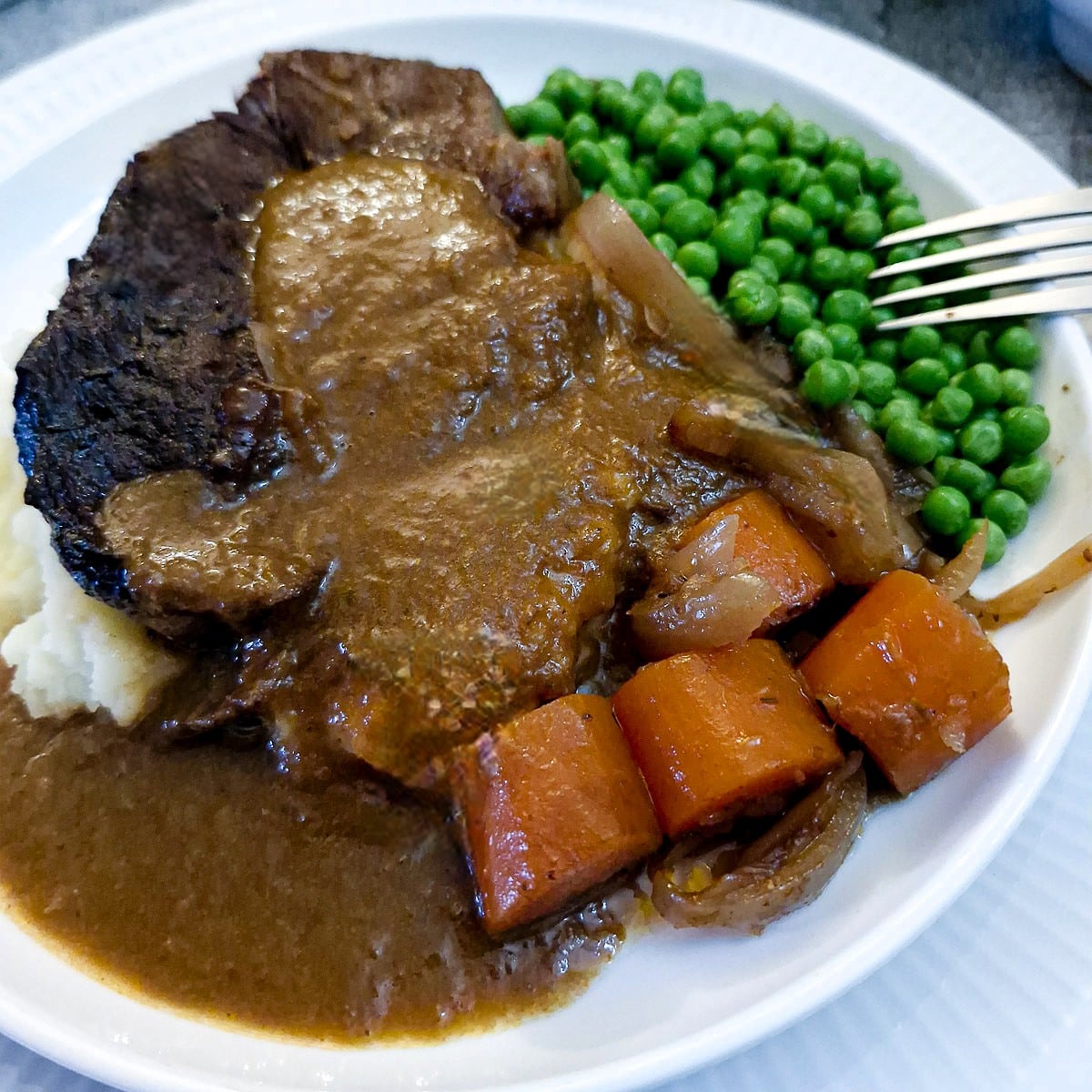
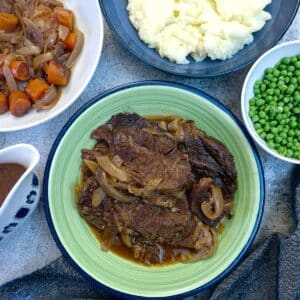
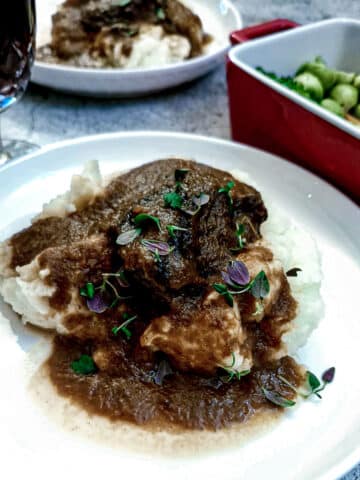
- Serve slices of featherblade steak on a bed of mashed potatoes and pour over a generous helping of gravy. Add a side dish of peas and/or other vegetables of your choice.
Tips for making slow-cooked beef and onions
Here are my top tips to ensure your slow cooker braised beef turns out perfectly every time:
- Don't worry about browning the onions before adding them to the slow cooker. Just throw them in - they'll soften and develop plenty of flavour as they cook slowly with the meat and stock.
- If you'd rather serve this dish with boiled potatoes instead of mash, you can add chunks of potatoes to the slow cooker along with the onions and carrots.
- Don't overcrowd the pan when browning the beef; sear it in batches. Use medium to high heat (the meat should sizzle when you add it to the pan); too low heat and the meat will draw water and boil rather than sear, which will make the meat fibres contract and shorten and ultimately end up tough.
- Don't add too much liquid. One cup of water (or stock) plus half a cup of red wine is plenty. The onions will release a lot of liquid, and there is very little evaporation in a slow cooker.
- If the gravy hasn't thickened sufficiently once it's been blended (which shouldn't happen if you've added enough grated potato), you can thicken it by stirring in a slurry made with 2 teaspoons of cornflour and 2 tablespoons of cold water. Stir it into the gravy in the slow cooker (on high heat) until the gravy thickens to your liking. You may not need all the cornflour mixture. Alternatively, you can do this in a saucepan on the stove.
Serving suggestions
I've already mentioned that you can serve the slow-braised beef on a bed of mashed potatoes, with your choice of vegetables on the side. Instead of plain mashed potatoes, how about serving the beef on a pile of vegetable mash? Here are a few of my favourite versions (and don't forget to pour lots of the delicious gravy over the top).
- Boereboontjies - South African green beans and onions mashed with potatoes.
- Rumbledethumps - Scottish root vegetable mash.
- Spring green potato mash - made with tasty early spring cabbage and lots of black pepper.
- Irish colcannon - made with leeks and cabbage.
Variations
This is a basic recipe, and you should be able to build on it to make it your own. Here are a few ideas:
- Mushrooms. Beef and mushrooms pair really well together. Add a punnet of button mushrooms at the start, or 1 or 2 cups of sliced mushrooms. If you are catering for picky eaters who don't like the texture of mushrooms, simply blend the mushrooms finely in a food processor and stir them in with the stock. You won't notice the mushrooms, but they will add a lovely flavour to the gravy.
- One-pot meal. Make it a complete one-pot meal by adding chunks of potatoes and extra vegetables such as parsnips, shredded cabbage, chopped celery (basically any 'hard' vegetable at the start. Softer vegetables such as sweet potatoes, butternut, green beans, etc., can be added halfway through.
- Beer or ale. Instead of red wine, add a good quality beer, ale or stout for a richer, more robust gravy.
- Add a touch of sweetness. A spoonful of redcurrant jelly or cranberry sauce stirred into the gravy towards the end of the cooking time complements the beef and balances the acidity of the wine.
Equipment
There's not much equipment needed to make slow cooker beef with onion gravy.
- Slow cooker. Size-wise, you need a slow cooker large enough to hold all the ingredients. If your slow cooker is a little on the small side, as long as you can fit the lid on, you'll be fine. The onions cook down quite a bit during cooking, so don't worry if the slow cooker looks a little full at the start.
- Frying pan. This is for searing the steak. It's a good idea to sear the beef before adding it to the slow cooker. Not only does searing add extra flavour, but it also helps seal the juices into the meat, resulting in a more succulent outcome.
- You'll also need the more mundane items such as a vegetable peeler, chopping board, sharp knife and a spatula.
Storage and freezing
- Refrigerator. Leftovers can be cooled and stored in a covered container in the refrigerator for up to 3 days.
- Freezer. This recipe freezes like a dream. If you've made a large batch (make-ahead or meal prep), pack the meat with the onion gravy into meal-sized containers and freeze for up to 4 months. Leftovers can also be frozen for the same length of time.
- Defrosting. Allow the frozen beef to defrost slowly in the refrigerator before reheating.
- Reheating. Transfer the defrosted or leftover beef to a saucepan and reheat over a low to moderate heat on the stove until piping hot. As soon as the meat is well heated through, remove the pan from the stove so as not to overcook the meat.
FAQ
Check the label on these ingredients:
Worcestershire sauce - some brands contain malt vinegar or other gluten-containing ingredients.
Beef stock - some stock cubes, stock pots and beef concentrates contain wheat or barley-derived ingredients.
Creamed horseradish - is usually gluten-free, but it's worth checking the label.
Dijon mustard - generally gluten-free, but again, check the label to be 100% sure.
Finally, if you are thickening the gravy, avoid using flour. Use cornflour (cornstarch), arrowroot or potato starch instead.
Absolutely. While featherblade steak is ideal for slow cooking, other suitable cuts include braising steak, chuck steak, shin of beef, brisket, flank or stewing beef. Any cut with good marbling and connective tissue will become tender after long, slow cooking.
Most of the alcohol will evaporate during the long cooking process, leaving only the flavour of wine or beer. However, trace amounts may remain, making this dish unsuitable for those who avoid alcohol entirely.
Slow-cooked beef can sometimes seem tough before it becomes tender. Ensure you follow the timing in the recipe (7 to 8 hours on low / 4 to 5 hours on high). If the meat isn't easily pulled apart with a fork, it usually needs more time; continue to cook until the connective tissue has fully broken down.
Yes, assemble the dish in a large covered casserole or Dutch oven rather than the slow cooker. Add an extra half cup of stock to compensate for any evaporation, and cook at 150C / 300F for 3 to 4 hours until the meat is fork-tender. Check periodically to ensure there is sufficient liquid still in the dish.
Depending on appetite, you should allow between 113 to 170 grams, or 4 to 6 ounces of raw stewing beef per person. The beef loses moisture and renders fat during the cooking process, so the final cooked weight will be lower.
If you're cooking for more than 4 people, you might like to add an extra onion and carrot to the slow cooker, and if you want a lot of gravy, increase the stock by half a cup.
The flavouring ingredients should not need adjusting, but you can taste the gravy halfway through and add a small amount of extra flavourings as necessary.
Save for later
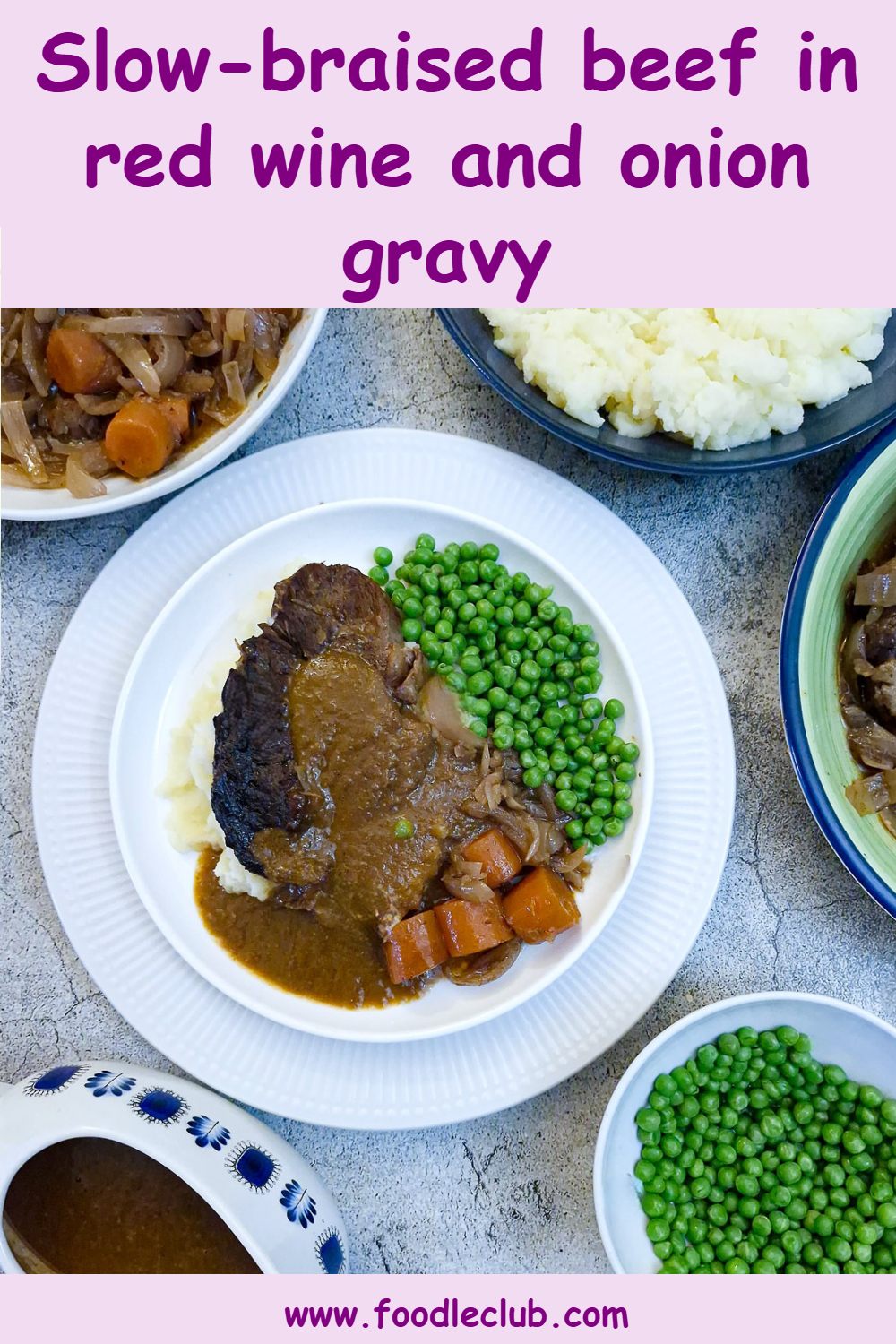
If you would like to make this slow cooker braised beef and onions, why not save the recipe to one of your Pinterest boards so you can find it easily? Just click the image below.
Alternatively, you can save the recipe by clicking on the floating heart icon on the right-hand side of the screen.
Related recipes
Visit my beef recipes page for other ideas using beef. Here are a few you might enjoy:

The recipe
Slow braised beef in red wine and onion gravy
(Click the stars to rate this recipe)
Equipment
- Slow cooker large enough to hold the meat, vegetables and stock.
- Frying Pan
- Vegetable peeler
- Sharp Knife
- Chopping Board
- Spatula
Ask a Question
If you have a question about this recipe that has not been answered, please use the box below to ask it.
Use this with care. This is an AI-generated result and may contain errors or inaccuracies. I cannot be held responsible for the information returned.
Ingredients
- 1½ pounds / 680 grams stewing beef eg featherblade, flat iron, chuck, flank, topside, or brisket.
- 3 large onions peeled and sliced
- 3 large carrots peeled and cut into chunks
- 1 - 2 medium potatoes peeled and grated
- 2 cloves garlic finely sliced
- 1 beef stock pot
- 1 cup / 240 ml boiling water
- ½ cup / 120 ml red wine
- ½ - 1 teaspoon salt
- 2 - 3 tablespoons Sunflower or other neutral flavoured cooking oil
Flavourings
- 2 tablespoons Worcestershire sauce
- 2 tablespoons tomato puree (tomato paste)
- 1 teaspoon dried thyme
- 2 teaspoons Dijon mustard optional
- 1 tablespoon creamed horseradish optional
- ½ teaspoon salt if required
Instructions
- Place the sliced onions, chunked carrots, grated potato and finely chopped garlic into the slow cooker.3 large onions, 3 large carrots, 1 - 2 medium potatoes, 2 cloves garlic
- Heat a drizzle of cooking oil in a frying pan. Sprinkle the beef lightly with salt and sear it over medium to high heat on both sides. Do this in batches - don't overcrowd the pan.½ - 1 teaspoon salt, 2 - 3 tablespoons Sunflower or other neutral flavoured cooking oil, 1½ pounds / 680 grams stewing beef
- Arrange the seared beef on top of the vegetables in the slow cooker.
- Dissolve the stockpot in a large jug in one cup of boiling water, then stir in the red wine, Worcestershire sauce, tomato puree, horseradish, mustard and thyme. Pour it over the meat and vegetables.1 beef stock pot, 1 cup / 240 ml boiling water, ½ cup / 120 ml red wine, 2 tablespoons Worcestershire sauce, 2 tablespoons tomato puree (tomato paste), 1 teaspoon dried thyme, 2 teaspoons Dijon mustard, 1 tablespoon creamed horseradish
- Cover the slow cooker with a lid and cook on low for 7 to 8 hours or on high for 4 to 5 hours until the meat is tender. Check for seasoning halfway through, and add salt if necessary.½ teaspoon salt
- Transfer the meat to a serving plate. If you've used large pieces of stewing beef as I have done, use a spatula to help you transfer the meat so it doesn't break up.
- Transfer most of the carrots and onions to a serving dish (they make a delicious side), leaving the cooking juices and about a cup of carrots and onions in the slow cooker.
- Use a stick blender to blend the gravy to a smooth paste and pour it into a gravy boat or small jug.
- Serve slices (or pieces) of braised steak on a bed of mashed potatoes and pour over a generous helping of gravy. Add a side dish of peas and/or other vegetables of your choice.
Notes
- Don't worry about browning the onions before adding them to the slow cooker. Just throw them in - they'll soften and develop plenty of flavour as they cook slowly with the meat and stock.
- If you'd rather serve this dish with boiled potatoes instead of mash, you can add chunks of potatoes to the slow cooker along with the onions and carrots.
- Don't overcrowd the pan when browning the beef; sear it in batches. Use medium to high heat (the meat should sizzle when you add it to the pan); too low heat and the meat will draw water and boil rather than sear, which will make the meat fibres contract and shorten and ultimately end up tough.
- Don't add too much liquid. One cup of water (or stock) plus half a cup of red wine is plenty. The onions will release a lot of liquid, and there is very little evaporation in a slow cooker
- If the gravy hasn't thickened sufficiently once it's been blended (which shouldn't happen if you've added enough grated potato), you can thicken it by stirring in a slurry made with 2 teaspoons of cornflour and 2 tablespoons of cold water. Stir it into the gravy in the slow cooker (on high heat) until the gravy thickens to your liking. You may not need all the cornflour mixture. Alternatively, you can do this in a saucepan on the stove.
- Mushrooms. Beef and mushrooms pair really well together. Add a punnet of button mushrooms at the start, or 1 or 2 cups of sliced mushrooms. If you are catering for picky eaters who don't like the texture of mushrooms, simply blend the mushrooms finely in a food processor and stir them in with the stock. You won't notice the mushrooms, but they will add a lovely flavour to the gravy.
- One-pot meal. Make it a complete one-pot meal by adding chunks of potatoes and extra vegetables such as parsnips, shredded cabbage, chopped celery (basically any 'hard' vegetable at the start. Softer vegetables such as sweet potatoes, butternut, green beans, etc., can be added halfway through.
- Beer or ale. Instead of red wine, add a good quality beer, ale or stout for a richer, more robust gravy.
- Add a touch of sweetness. A spoonful of redcurrant jelly or cranberry sauce stirred into the gravy towards the end of the cooking time complements the beef and balances the acidity of the wine.
- Refrigerator. Leftovers can be cooled and stored in a covered container in the refrigerator for up to 3 days.
- Freezer. This recipe freezes like a dream. If you've made a large batch (make-ahead or meal prep), pack the meat with the onion gravy into meal-sized containers and freeze for up to 4 months. Leftovers can also be frozen for the same length of time.
- Defrosting. Allow the frozen beef to defrost slowly in the refrigerator before reheating.
- Reheating. Transfer the defrosted or leftover beef to a saucepan and reheat over a low to moderate heat on the stove until piping hot. As soon as the meat is well heated through, remove the pan from the stove so as not to overcook the meat.
Nutrition
I am not a nutritionist. The nutrition information has been calculated using an on-line calculator, and is intended for information and guidance purposes only. If the nutrition information is important to you, you should consider calculating it yourself, using your preferred tool.
If you made this recipe and enjoyed it, I'd love it if you could give me a star rating in the comments below. And if you'd like to get in touch, you can email me at veronica@foodleclub.com. I'd love to hear from you. And don't forget to subscribe to my mailing list so you can grab yourself a copy of my FREE COOKBOOK!
If you'd like to continue browsing, just click on this link to all my recipes.

Did you make this recipe? Let me know!