
This post may contain affiliate links. As an Amazon Associate I earn from qualifying purchases.
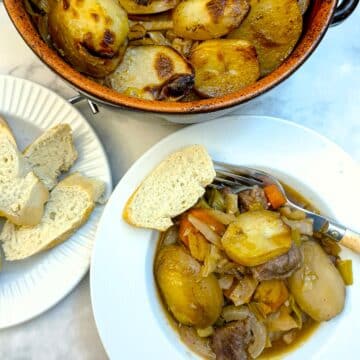
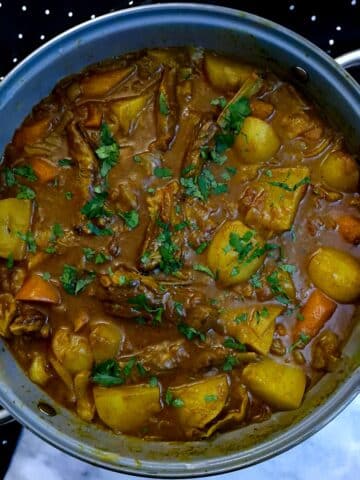
A lamb potjie is made with tender chunks of lamb, slow-braised with vegetables, sliced potatoes and spices, and makes a delicious supper with virtually no effort on your part. Serve with rice or crusty bread to soak up every last drop of the tasty gravy.
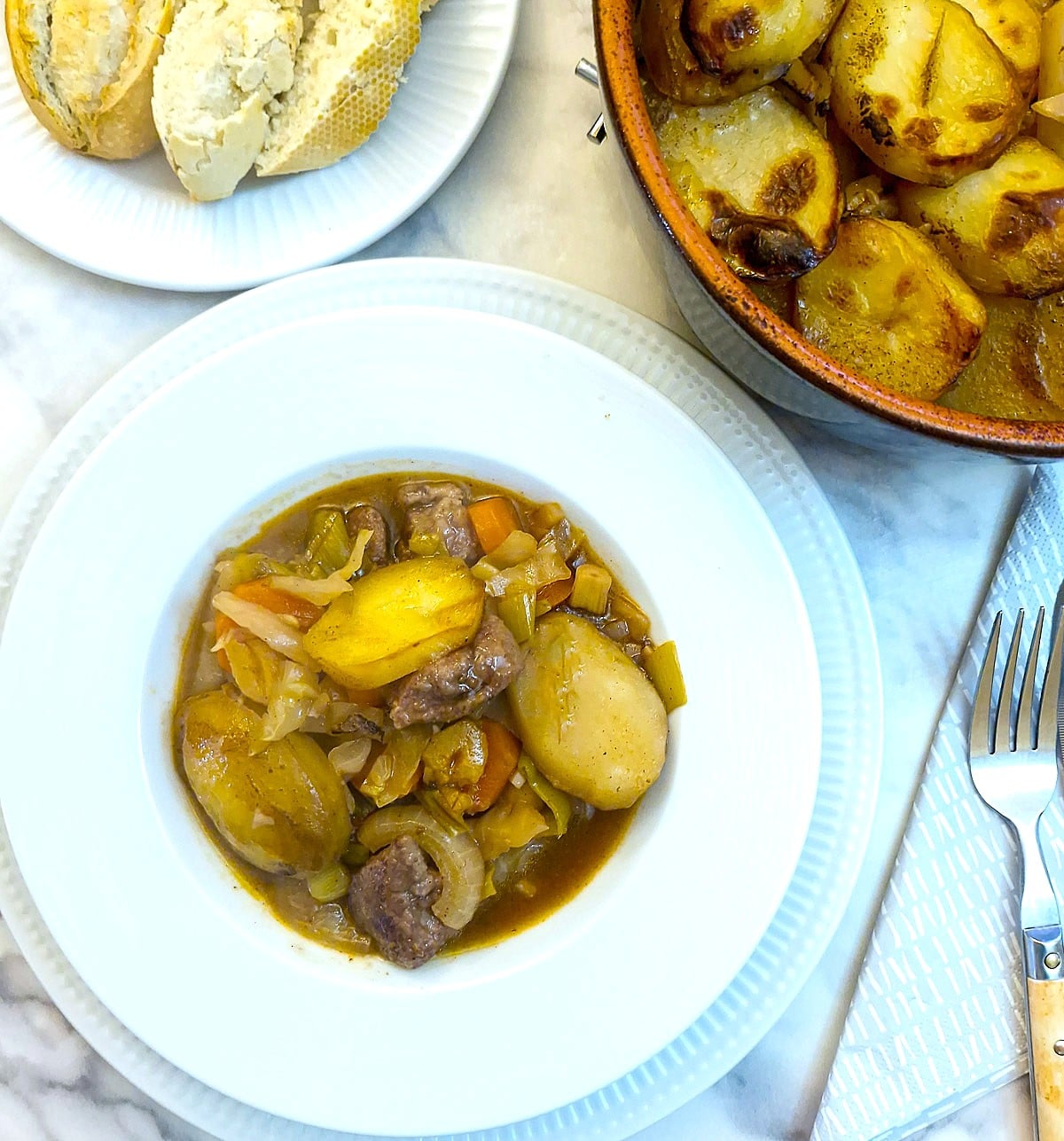
You simply can't beat old, tried and trusted recipes. This South African lamb stew (or lamb potjie) is one of those recipes that proves you don't need fancy ingredients to get great-tasting food. You might like to try this meat and potato pie too - it's another easy recipe that proves plain cooking can be tasty.
This is quite a long post, so you can use this index to jump to the section you are most interested in.
Table of Contents
- What is a potjie?
- Lamb potjie at a glance
- Why you'll should try this lamb potjie recipe
- Ingredients for a lamb potjie
- Instructions for making an oven-baked lamb potjie
- The gravy
- How to serve a lamb potjie
- Tips for a successful outcome
- Variations
- Equipment
- Storage and freezing
- FAQ
- Save for later
- Related recipes
- The recipe
What is a potjie?
A potjie or potjiekos (pronounced poy-key or poy-key-cos) is a traditional South African stew, cooked outdoors over an open fire for a few hours until the vegetables are tender and the meat is juicy and succulent. It is commonly made with beef, chicken or lamb, but it's not unusual to find venison or even ostrich in a potjie.
The stew gets its name from the container it's cooked in - the potjie - which is simply a heavy, three-legged cast-iron cauldron with a tightly fitting lid. Potjiekos literally translates to potjie food, or food cooked in a potjie.
I've been back in the UK for 20 years now, and in all that time I've never made or eaten a potjie, so I thought I'd turn my favourite South African lamb and apricot potjie recipe into an oven-baked potjie recipe. It's so easy - can't imagine why I didn't do it sooner!
Of course, if you happen to have a cast-iron cauldron and a garden larger than my pocket-handkerchief-sized one, you could quite easily make this lamb and apricot stew outside in the traditional way. See below for instructions if you'd like to try making it outdoors.
Lamb potjie at a glance
- How this lamb and apricot stew is made: Brown the meat, transfer it to a casserole dish and cover with layers of vegetables, finishing with a layer of sliced potatoes. Pour in the stock and bake in the oven on low heat for 2 to 2.5 hours. Remove the lid and brown the potatoes for the final 20 minutes.
- Main ingredients: Lamb, onions, leeks, carrots, cabbage, potatoes, spices and stock.
- Prep time: 30 minutes.
- Cooking time: 2.5 hours
- Yield: Serves 4.
- Difficulty: Easy
Why you'll should try this lamb potjie recipe
- Simple ingredients - big flavour. Nothing fancy - just everyday ingredients coming together into something really special.
- Easy, no-fuss cooking. Once everything is layered in the dish, the oven does all the work. Apart from taking the lid off the dish for the final 20 minutes to brown the potatoes, there's absolutely nothing else to do.
- A complete meal in one pot. You've got tender lamb, loads of vegetables and plenty of potatoes, all cooked together. I like a slice of crusty bread to soak up the gravy; my husband prefers mashing some of his potatoes into the gravy instead.
- Tastes even better the next day. I know this because I made a huge potful and warmed up the leftovers on the following night. The gravy had thickened a little, and the spices seemed to have mixed and mellowed - it was delicious!
- Pops of sweetness from the apricots. The apricots add little pops of sweetness that go so well with the lamb. I love them - but if they're not your cup of tea, simply leave them out. This is a versatile recipe that's easy to change to your own taste.
- Inspired by South African potjie cooking. This is my oven-friendly take on a traditional potjie - keeping all the flavours and character, but making it easy to cook at home without an open fire.
Ingredients for a lamb potjie
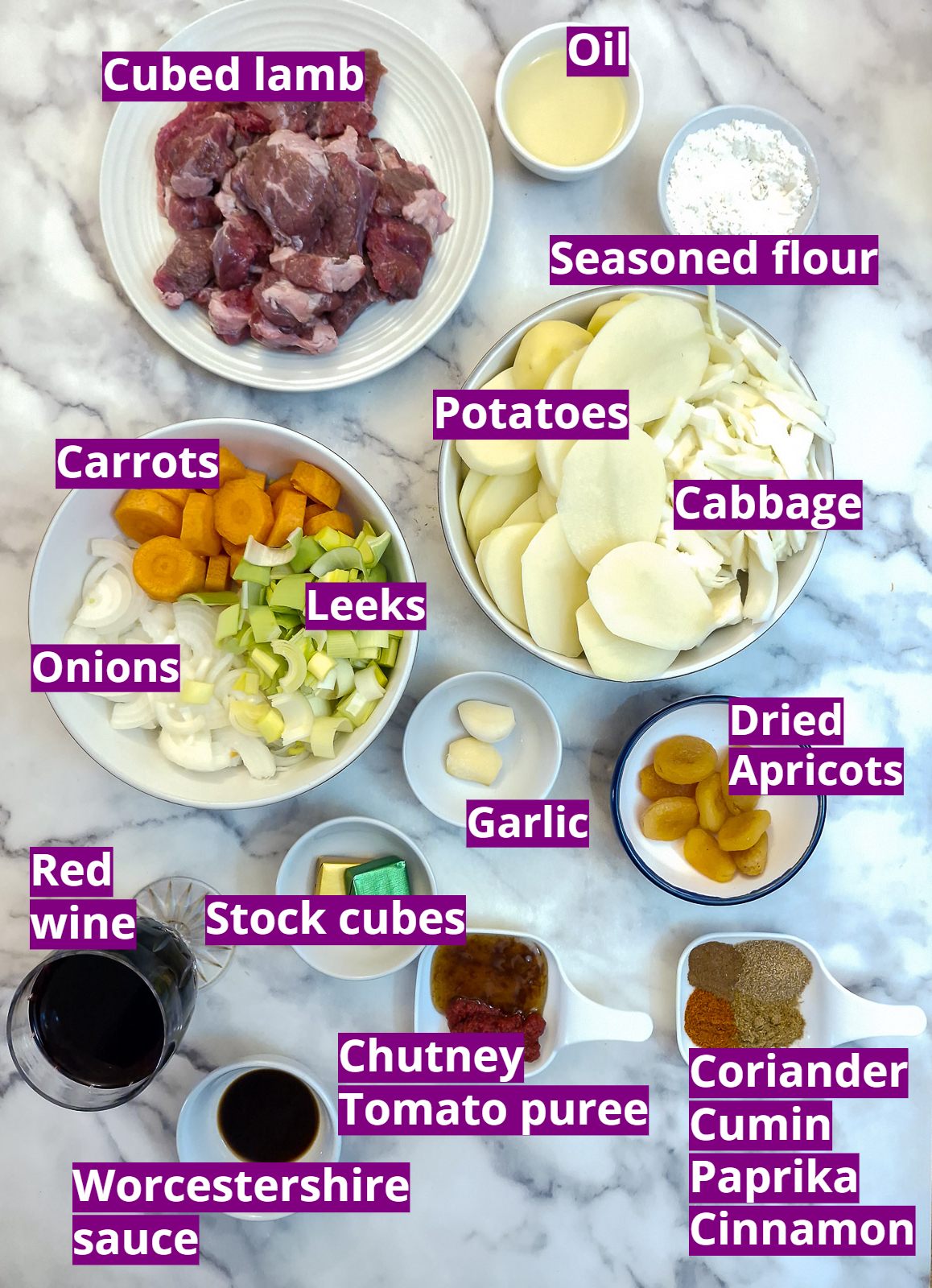
Before you panic and think that this is a lot of ingredients, it's really just meat and veg with a few everyday spices and flavourings.
**This is just an overview to explain why I used a particular ingredient. You can find the exact ingredient measurements you will need for this oven-baked lamb potjie on the printable recipe card at the end of this post.**
Meat
- Cubed lamb. I used boneless lamb leg, but you could use boneless lamb shoulder instead. This dish is cooked in the oven for a long time at a low temperature (a bit like cooking in a slow-cooker), and there's plenty of time for a boneless cut of lamb to tenderise and become succulent.
- Seasoned flour. This is used to coat the lamb before it is seared. It is flour that has been seasoned with salt and black pepper.
- Oil. Any neutral-flavoured vegetable oil will be fine. I tend to use rapeseed oil, but you could use sunflower oil instead. You need an oil with a high smoke-point so you can get it nice and hot to sear a good colour onto the lamb.
Vegetables
These are my suggestions, but you can substitute them with whatever vegetables you fancy or have available. Just stick more or less to the quantities I have suggested. The vegetables should be layered one on top of the other, rather than all mixed together and tipped in.
- Onions, leeks and garlic. These form the first layer. The onions and leeks should be sliced, and the garlic minced.
- Carrots and dried apricots. The second layer. The carrots should be peeled and cut into rings; the apricots should be coarsely chopped.
- Cabbage. I used a firm white cabbage, which was finely sliced and chopped. This forms the third layer.
- Potatoes. The potatoes should be peeled and thickly sliced - about one-quarter of an inch in thickness. They will be arranged on top of the vegetables to form the final layer.
Spices and flavourings
- Red wine. This gives a rich flavour to the lamb stew. If you prefer, you could use beer, or if you don't want to use alcohol, use grape or apple juice, or even extra stock.
- Spices. These are all warming spices which give a lovely flavour without spicy heat. I've used ground cumin, coriander, paprika and cinnamon. You could use either sweet or smoked paprika, depending on the flavour profile you are going for.
- Stock cubes. These are used to make the gravy. I used one chicken and one vegetable stock cube. I'd steer clear of using beef flavour as it would be too strong for the lamb.
- Chutney, Worcestershire sauce and tomato puree. These are combined with the stock before it is poured into the potjie. The chutney adds sweetness, the Worcestershire sauce adds saltiness, while the tomato puree (or tomato paste) adds a savoury depth. Any South African will normally grab a bottle of Mrs Balls Chutney, but if that's not available, you might like to try my green tomato chutney instead.
Instructions for making an oven-baked lamb potjie
(or how to cook a lamb potjie in the oven)
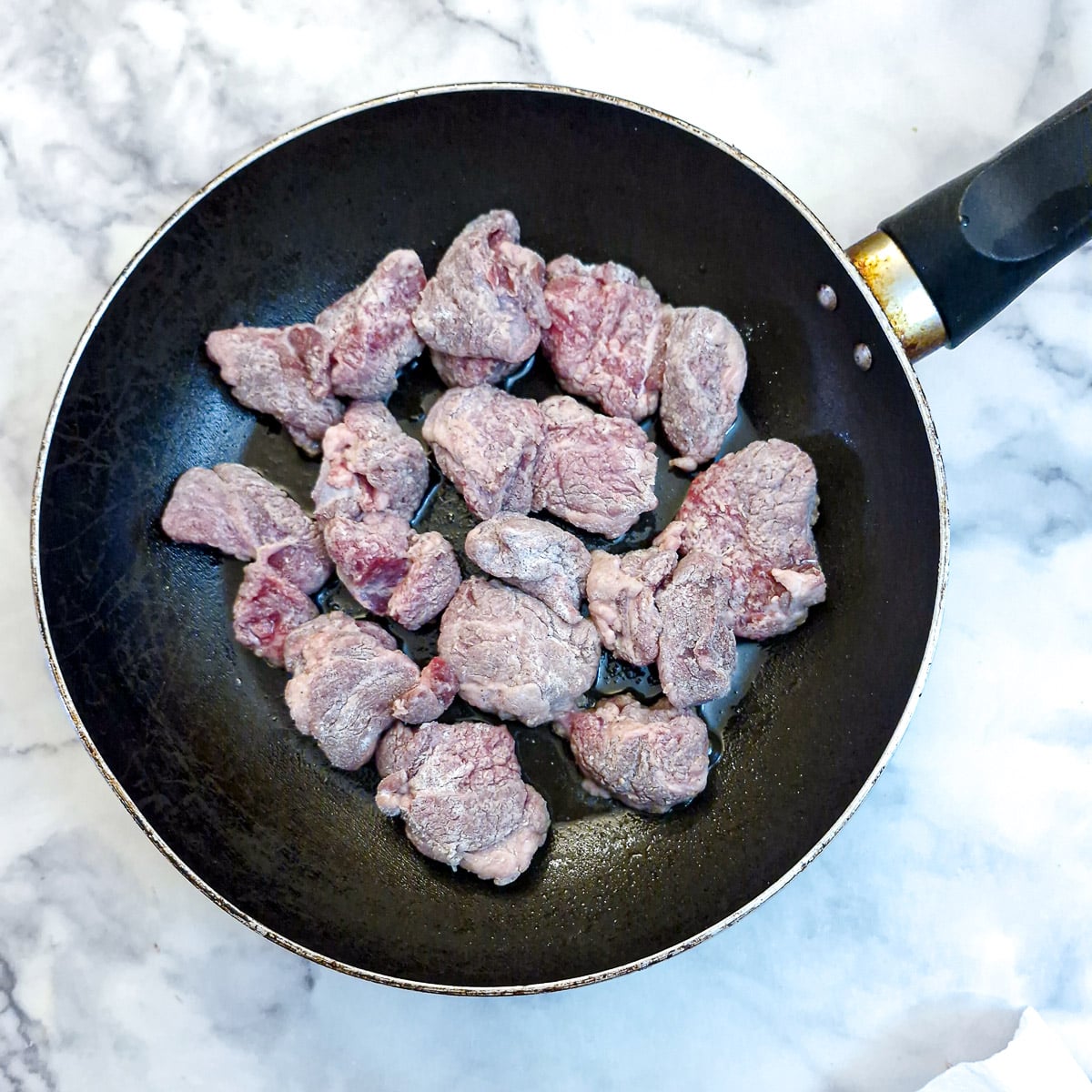
Step 1: Coat the lamb in seasoned flour. Heat the oil in a pan and add the meat.
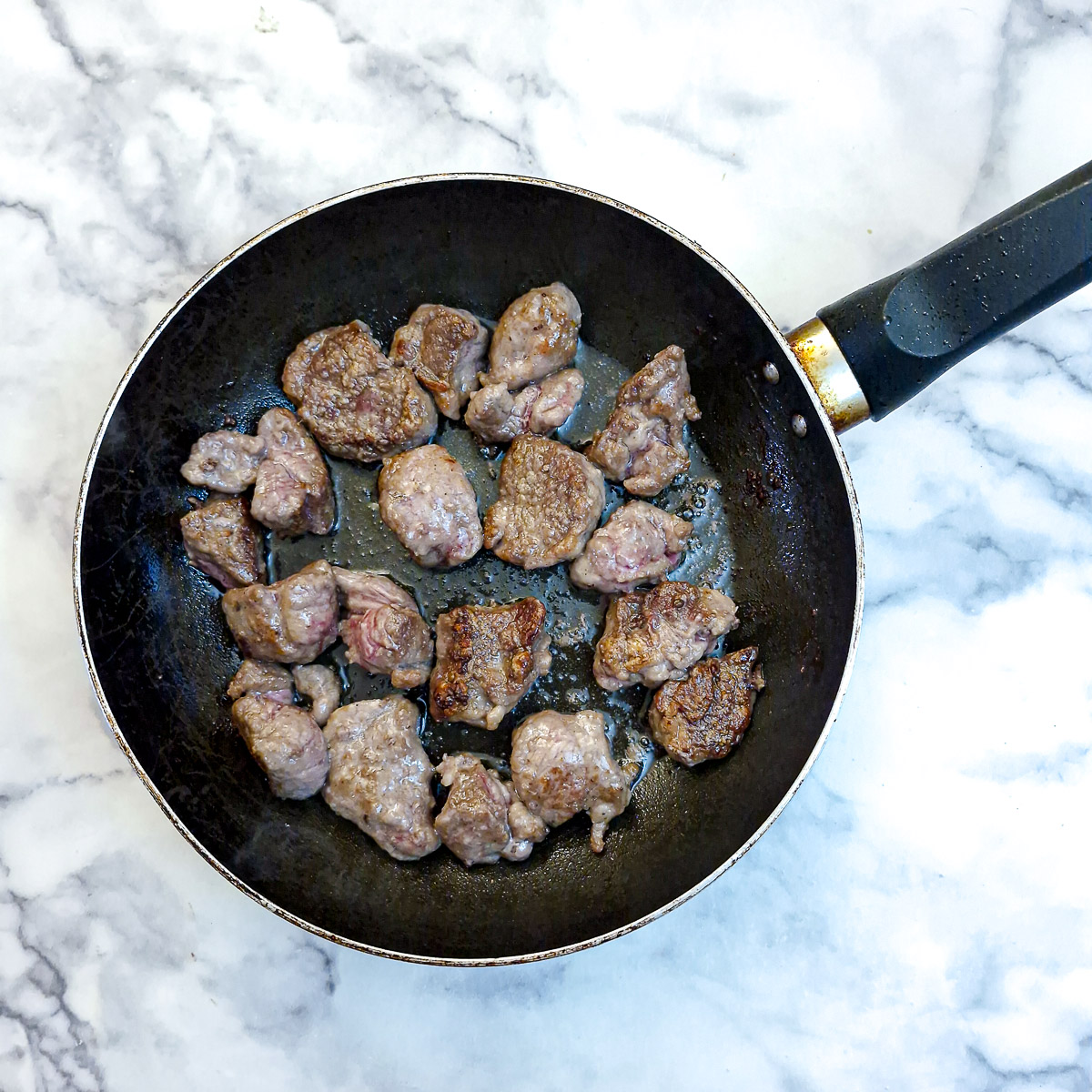
Step 2: Sear on all sides until nicely browned.
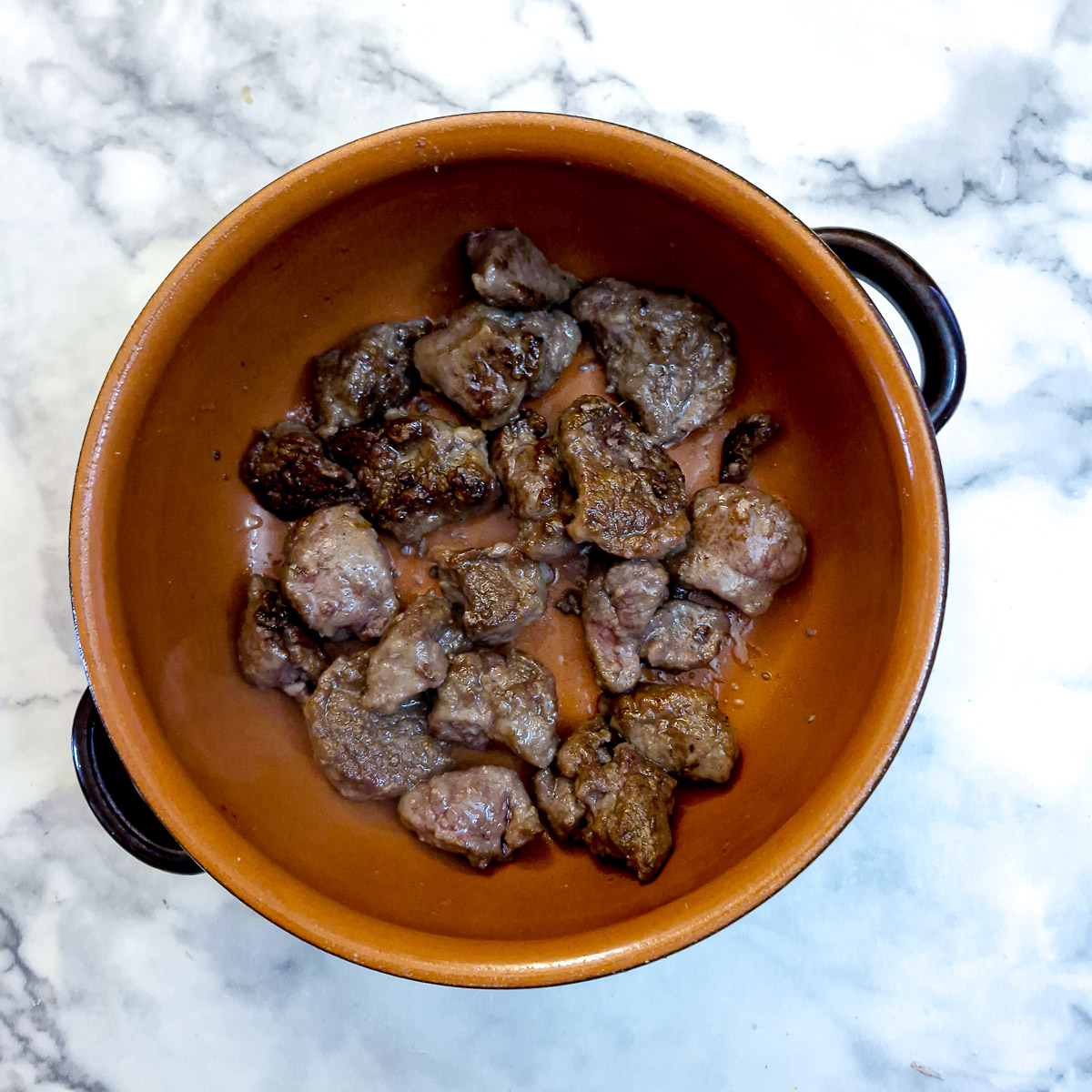
Step 3: Transfer the browned meat to a casserole dish, leaving any remaining oil in the pan. You can add another tablespoon of oil if necessary.
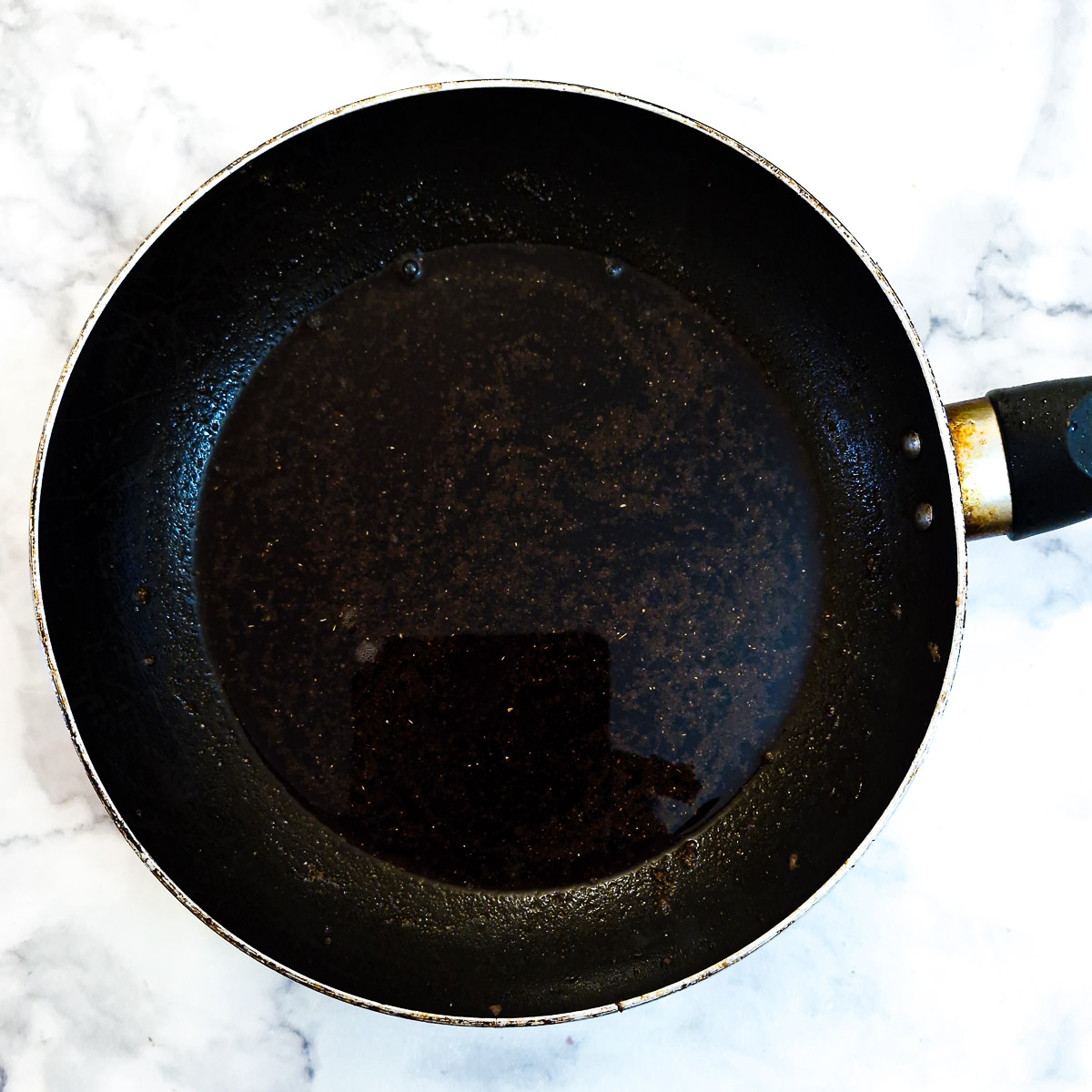
Step 4: Add the spices and stir them for 60 seconds until fragrant, then pour in the red wine (or beer) to deglaze the pan and scrape up any bits from the bottom of the pan.
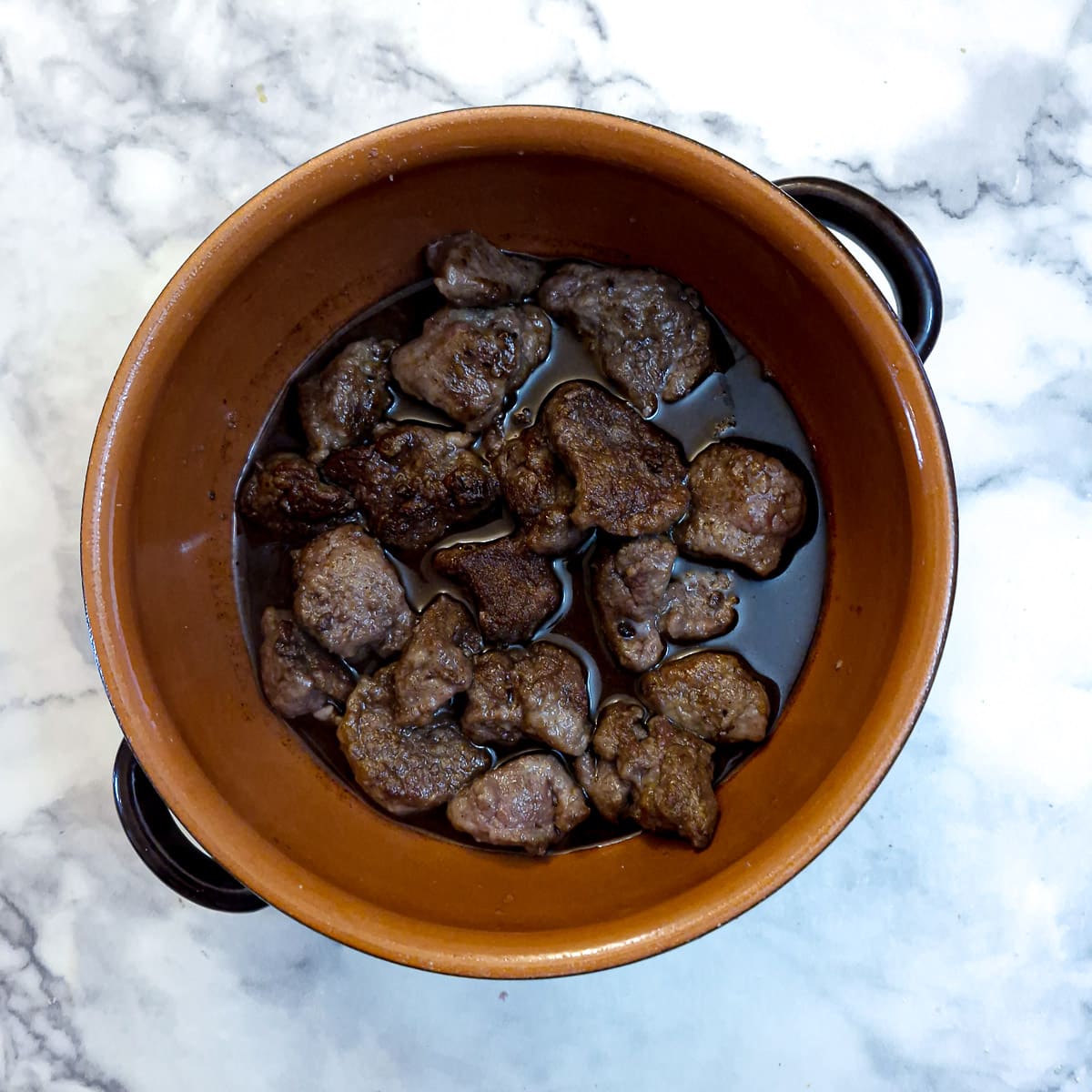
Step 5: Pour the wine and spices over the meat.
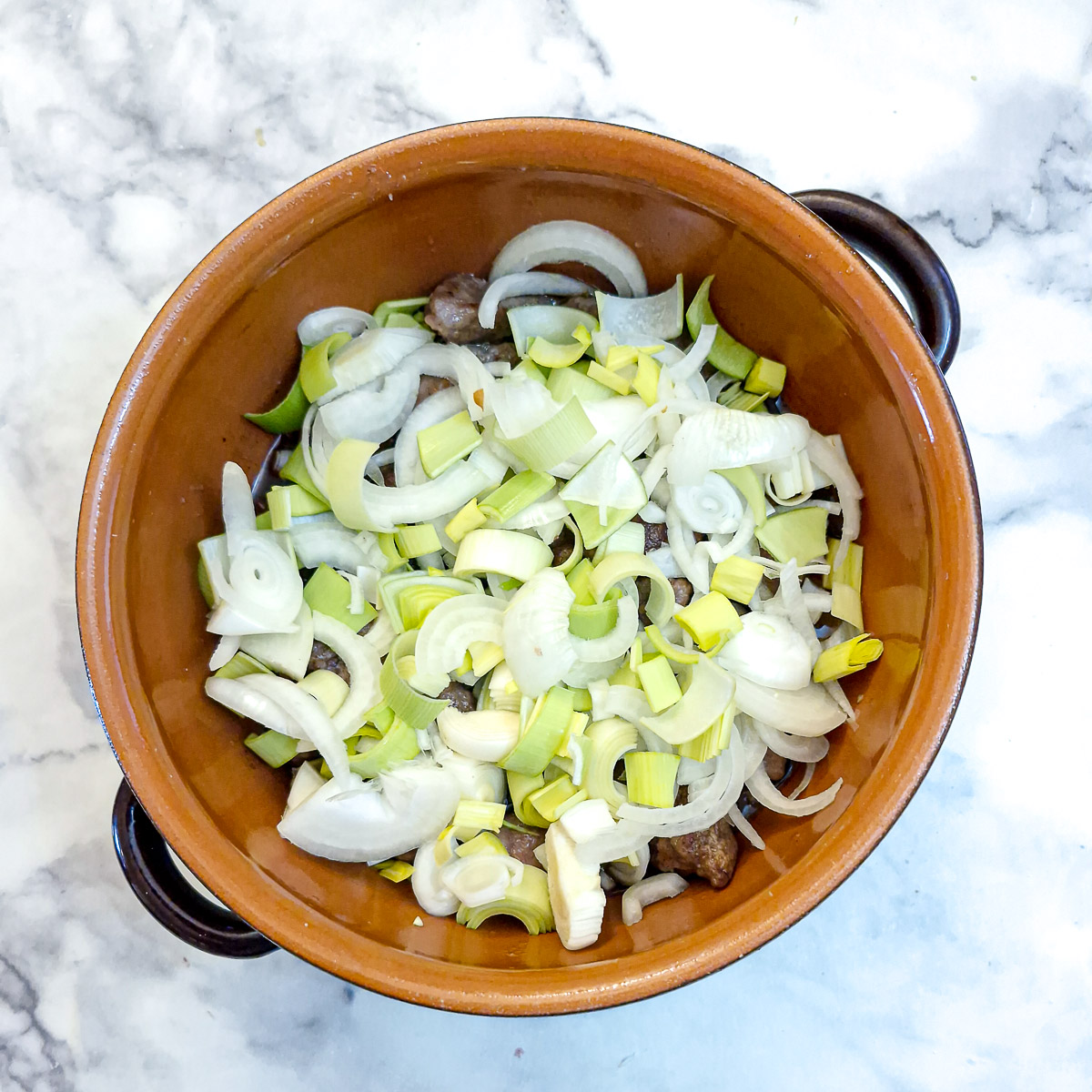
Step 6: Arrange the sliced onions, leeks and crushed garlic over the meat. Season very lightly with salt and black pepper.
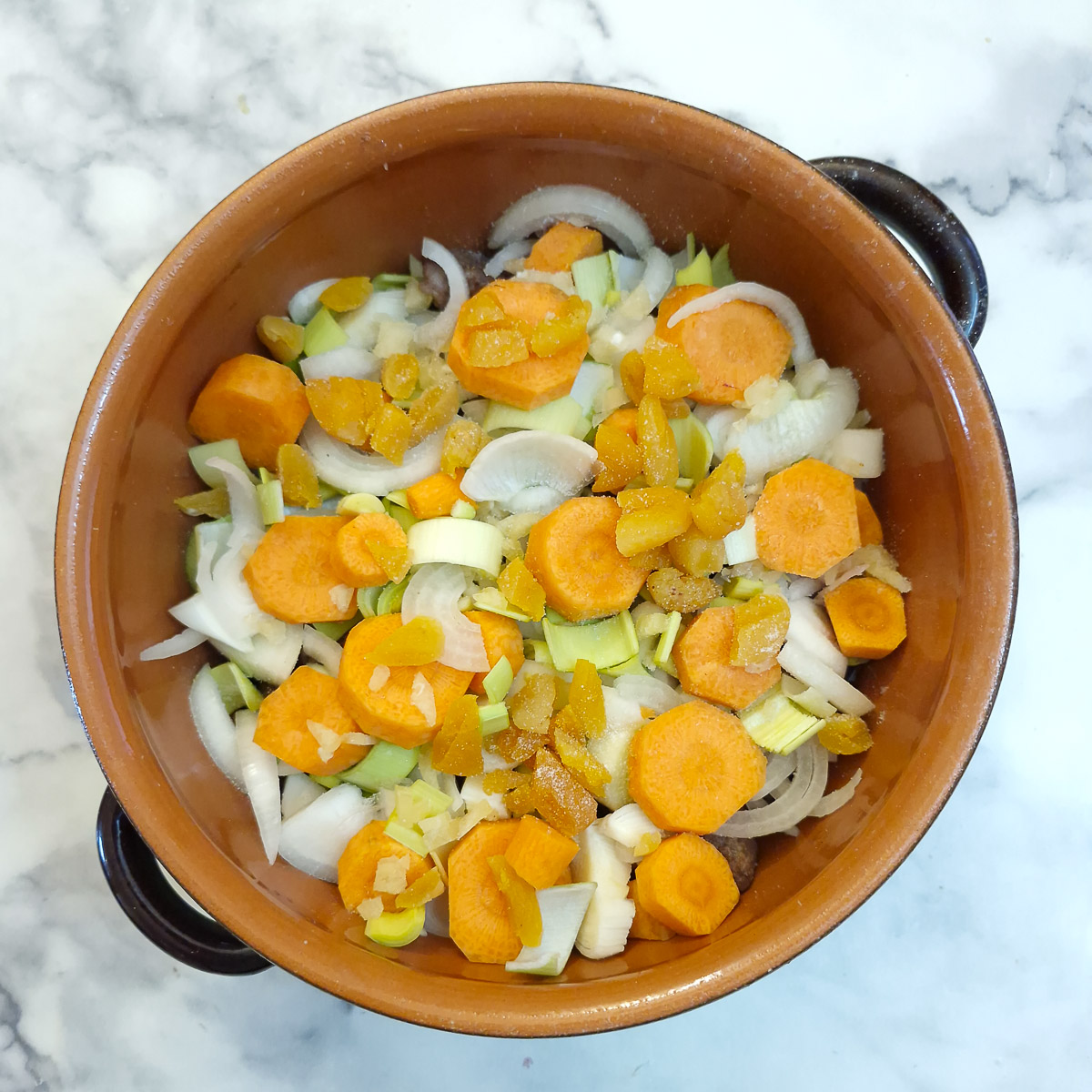
Step 7: Arrange the carrot rings and chopped apricots over the onions. Season very lightly with salt and black pepper.
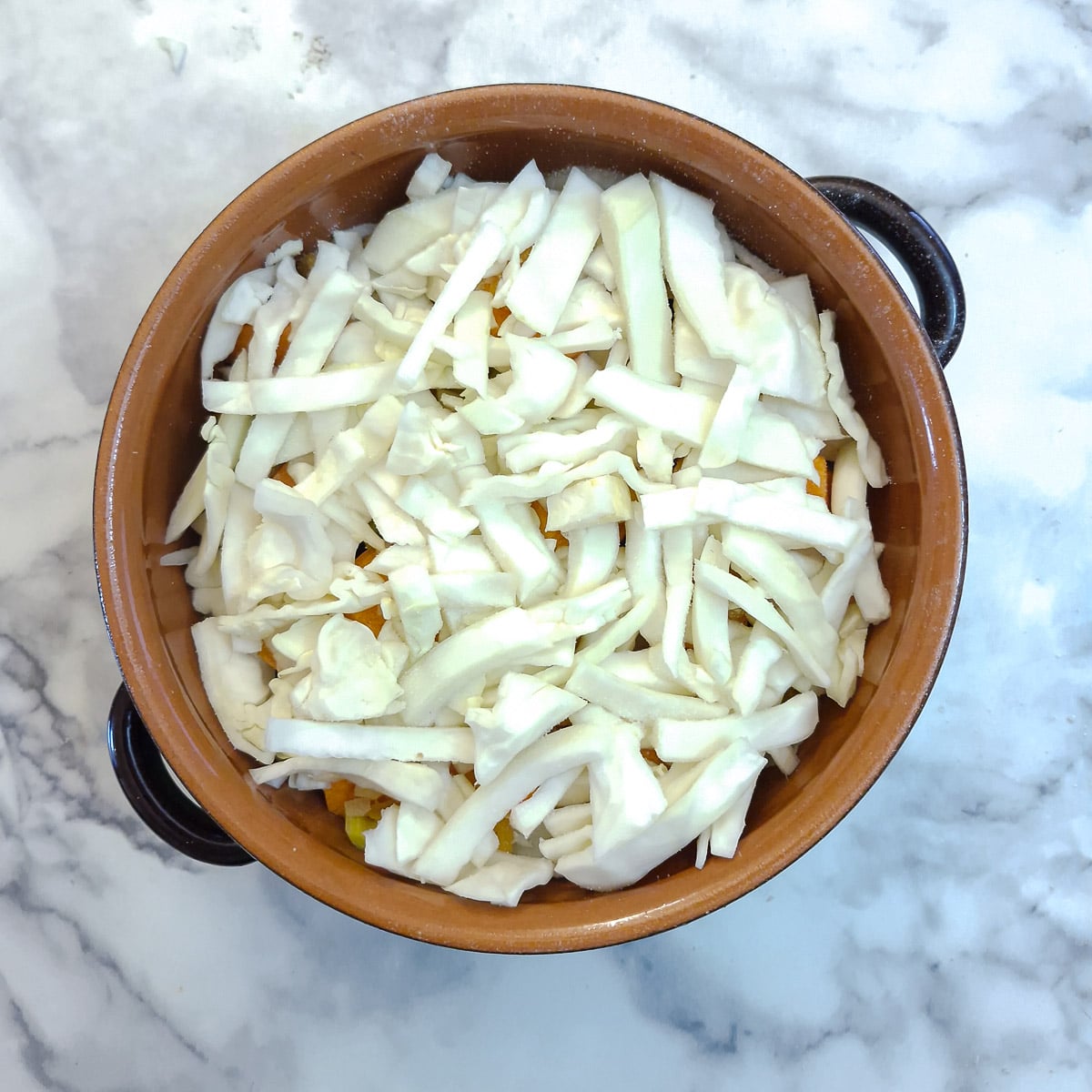
Step 8: Add the sliced cabbage. Season very lightly with salt and black pepper.
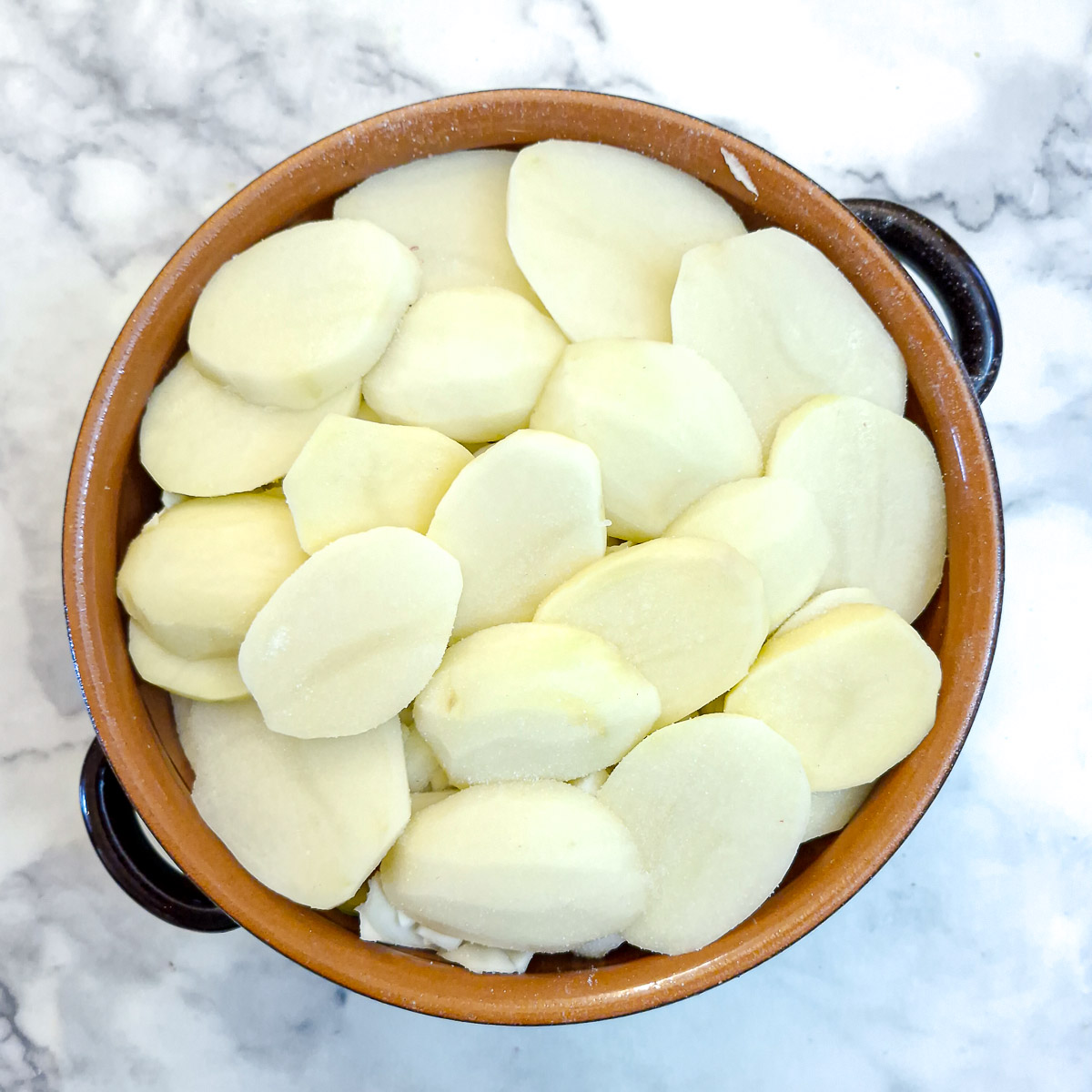
Step 9: Arrange the sliced potatoes on top of the cabbage and give a final light seasoning of salt and black pepper.
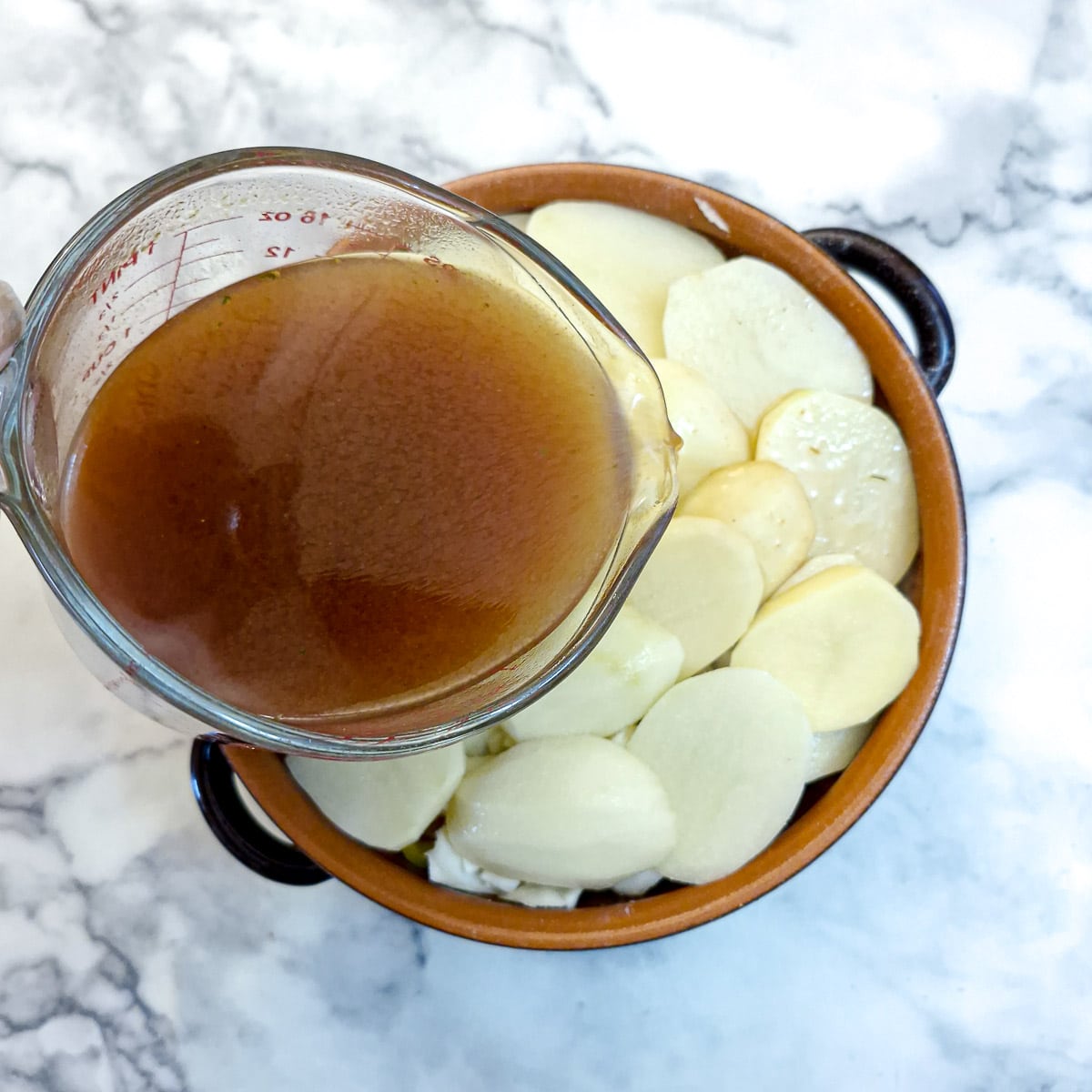
Step 10: Dissolve the stock cubes in 2 cups of boiling water and stir in the Worcestershire sauce, tomato puree and chutney. Pour the stock over the meat and vegetables.
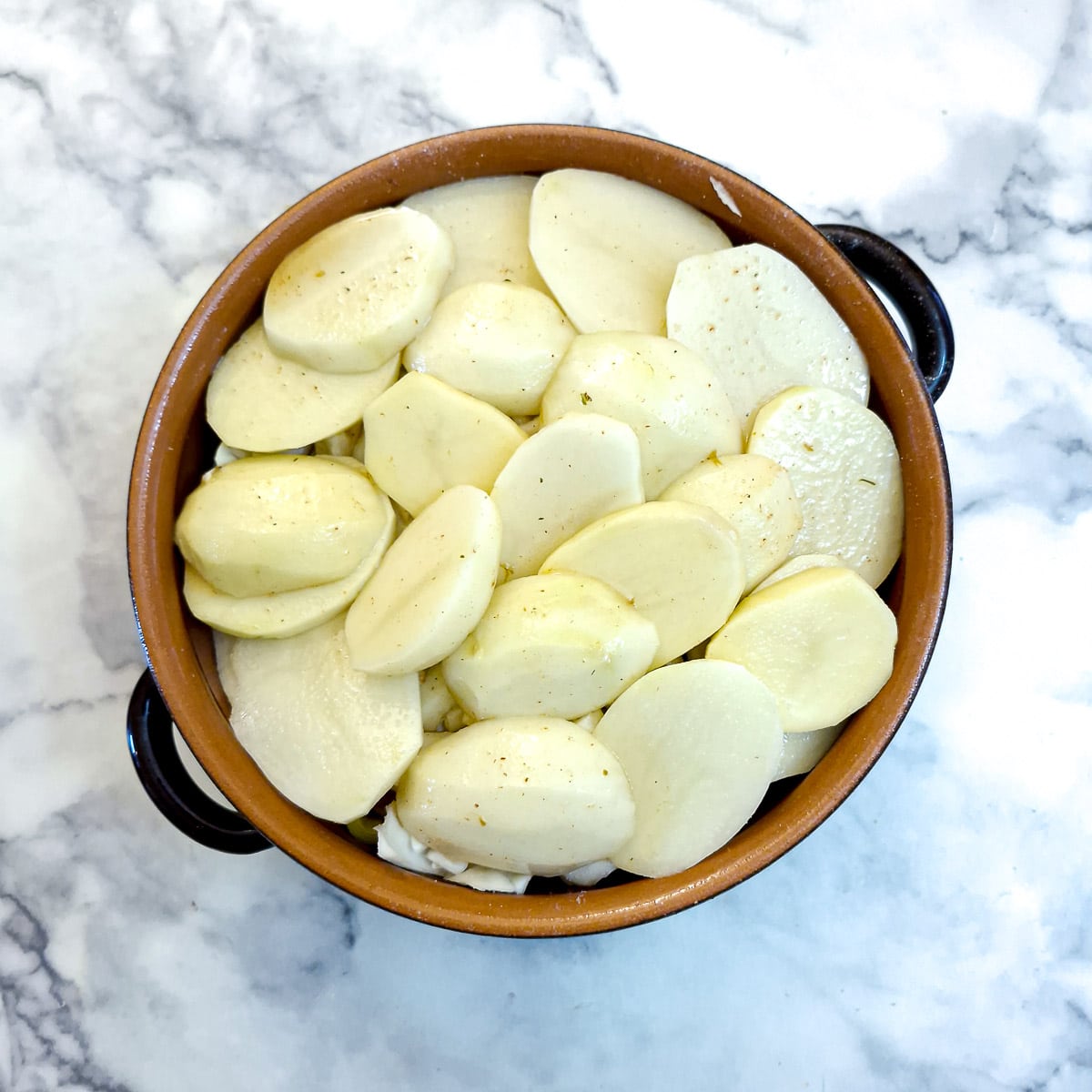
Step 11: Fill the dish two-thirds of the way with the stock. Reserve any remaining stock in case you need to top up.
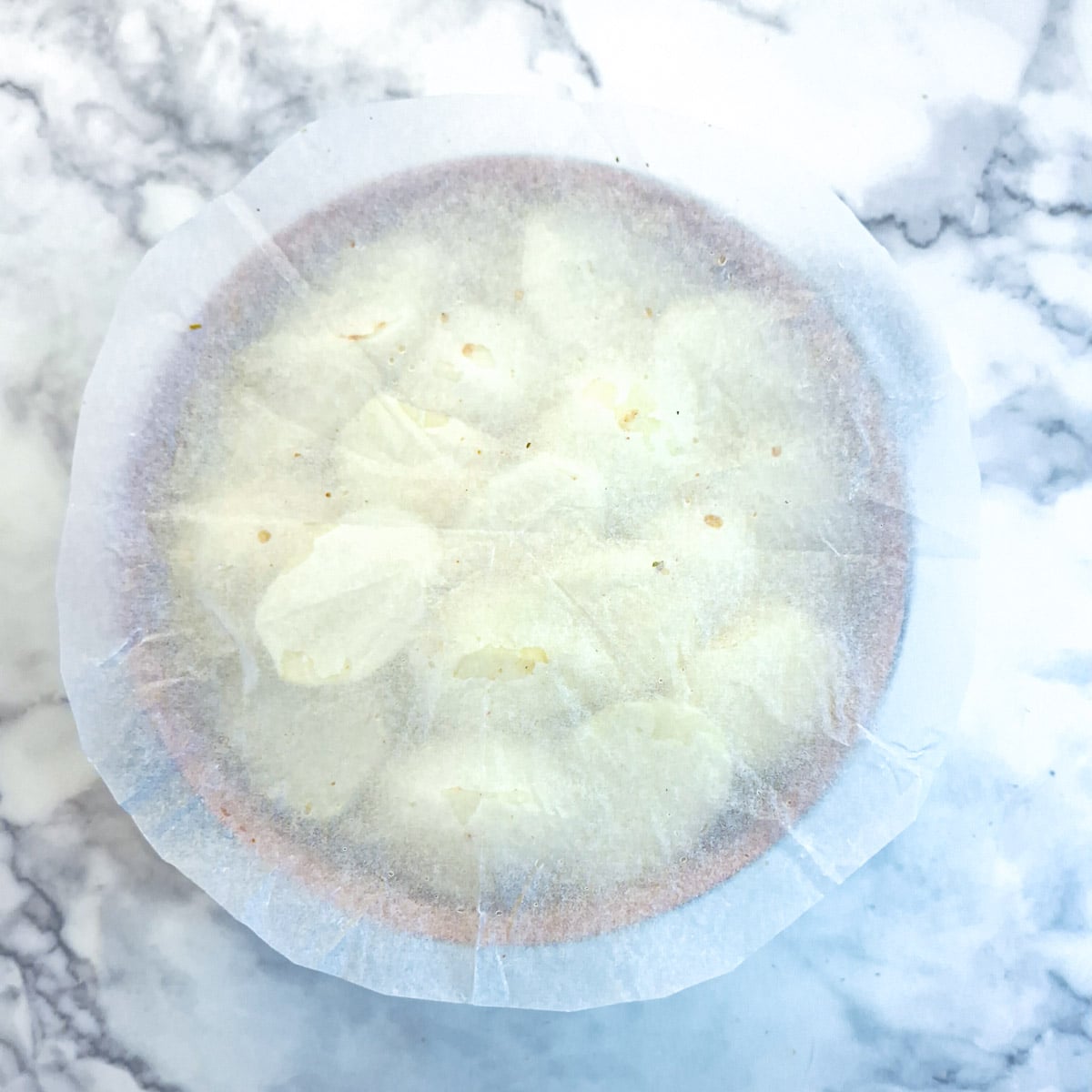
Step 12: If you have a casserole dish with a tightly fitting lid, skip to step 14. Otherwise, make a cartouche of baking paper and press it on top of the potatoes.
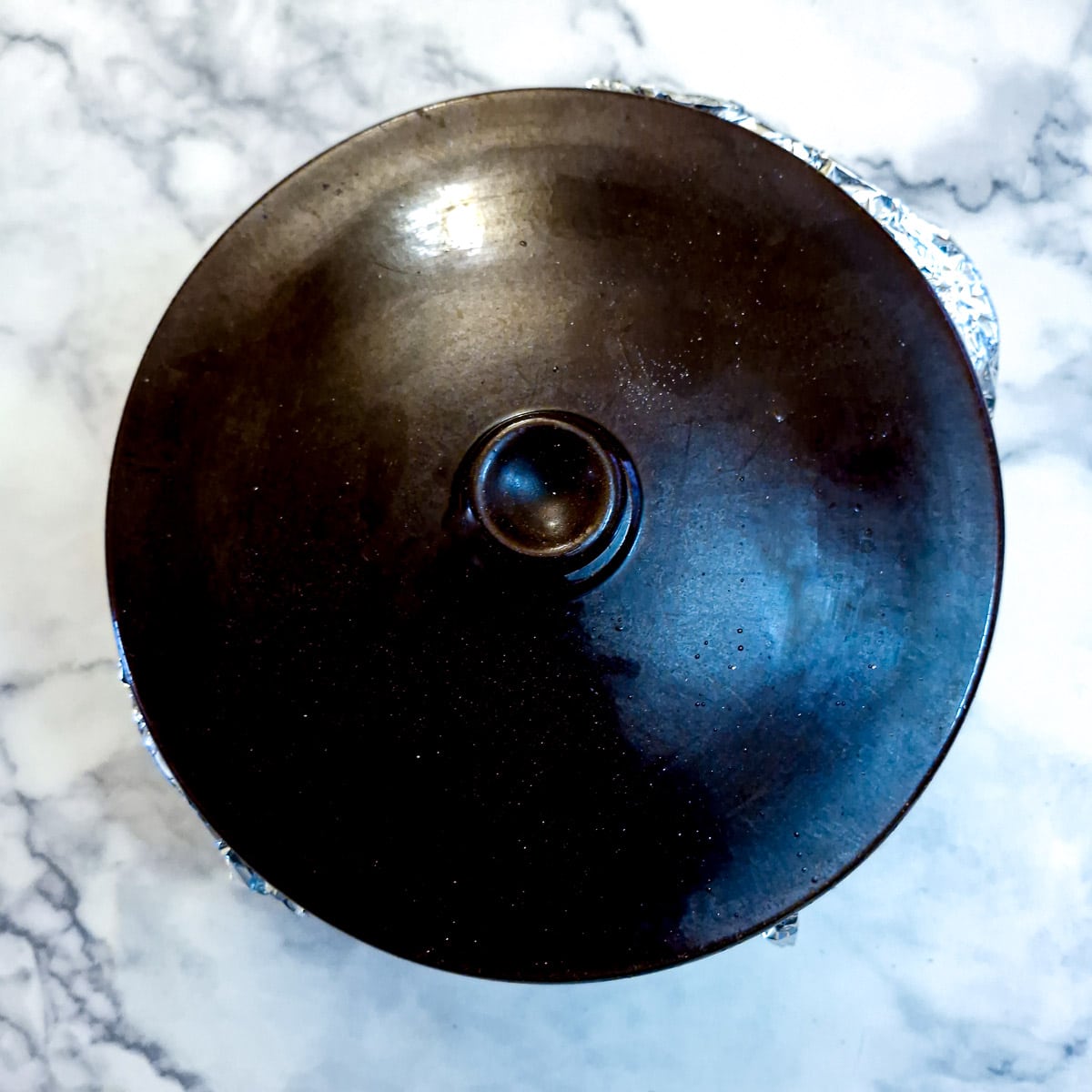
Step 13: Cover the dish tightly with tin foil and put the lid on top. The baking parchment and foil help to seal the dish and keep the steam in. This dish cooks slowly at a low heat, so it's important for the steam to stay in the dish.
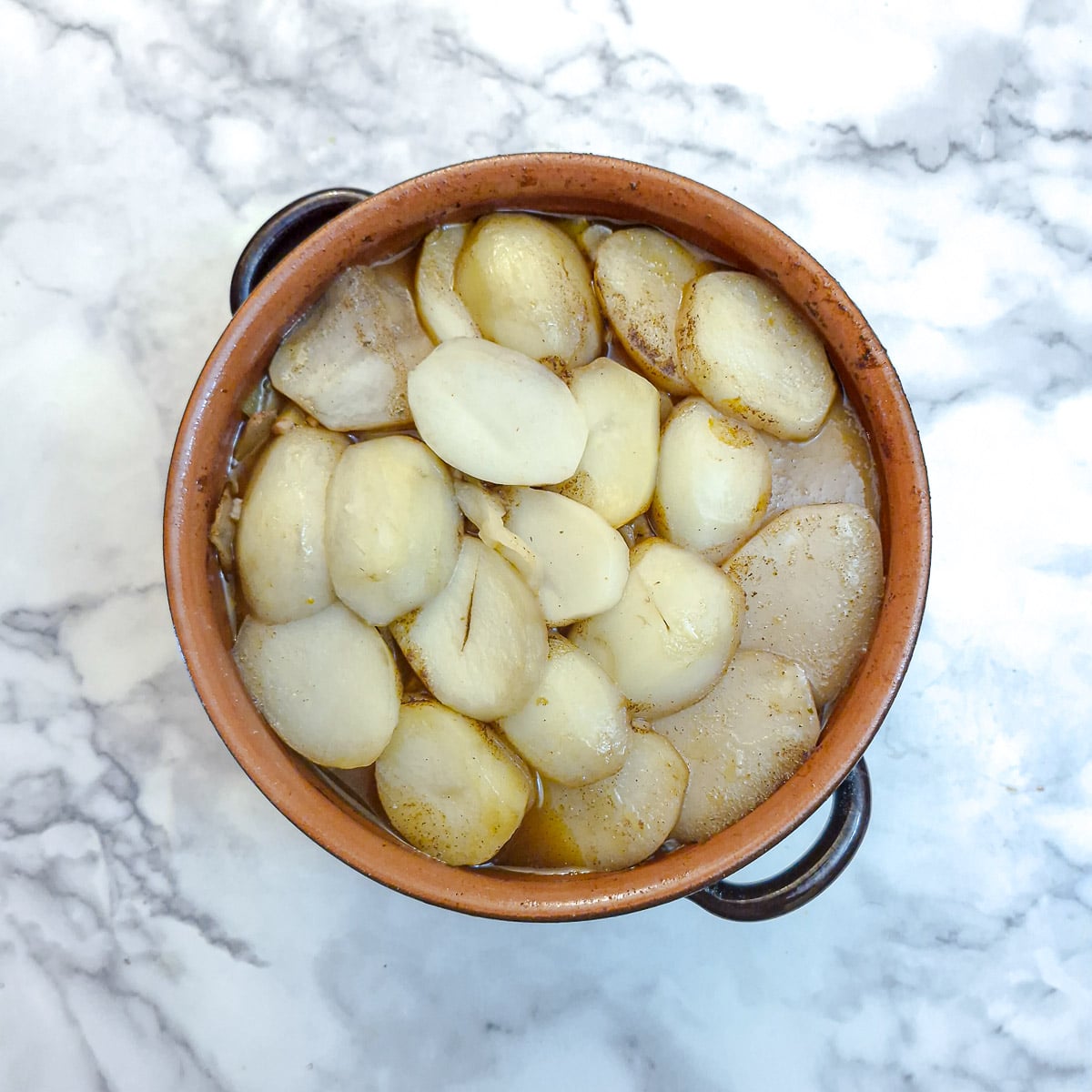
Step 14: Bake the covered lamb casserole in a pre-heated oven 150C/300F (conventional) or 140C/285F (fan) for 2 to 2.5 hours. Check after 1.5 hours and top up with the remaining stock if necessary.
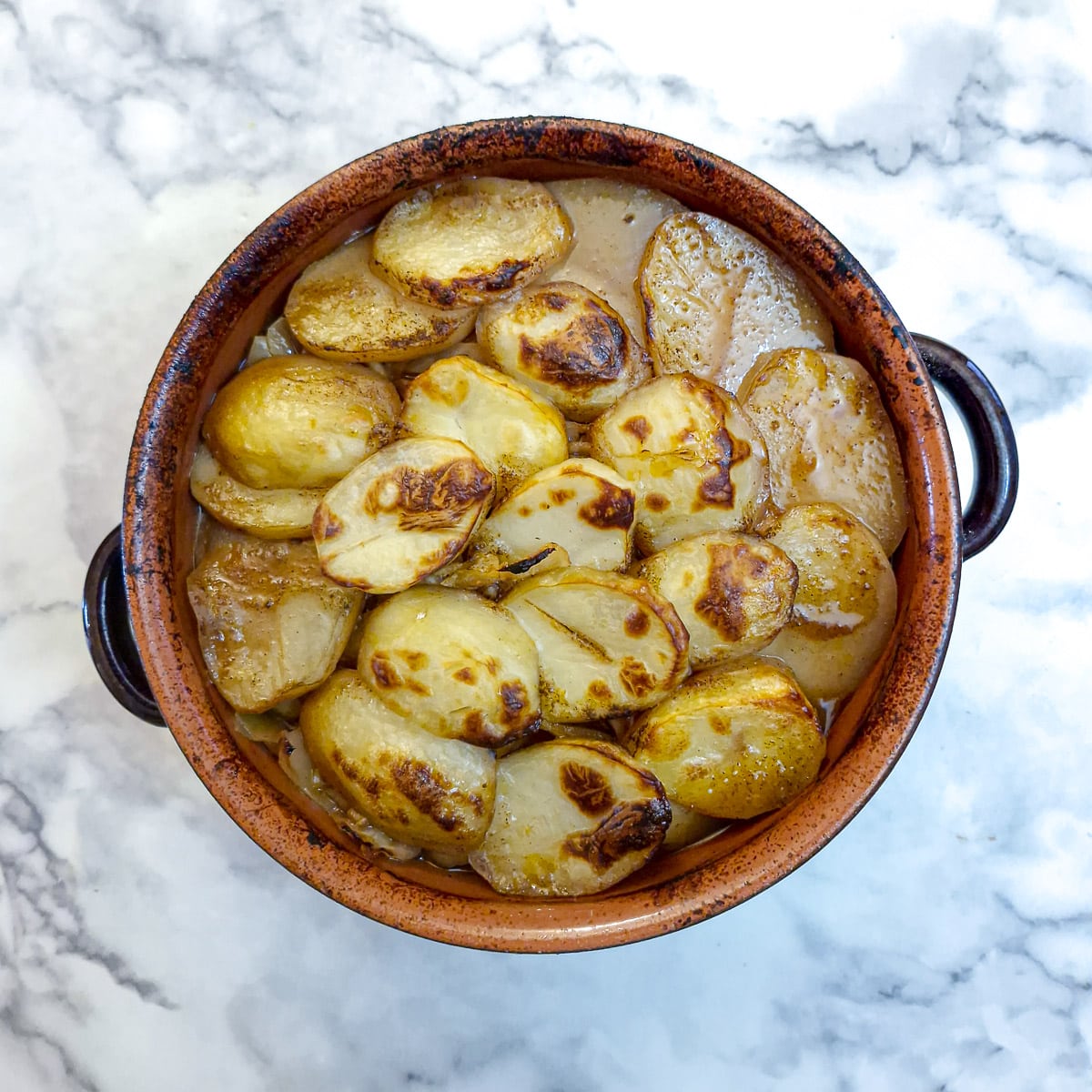
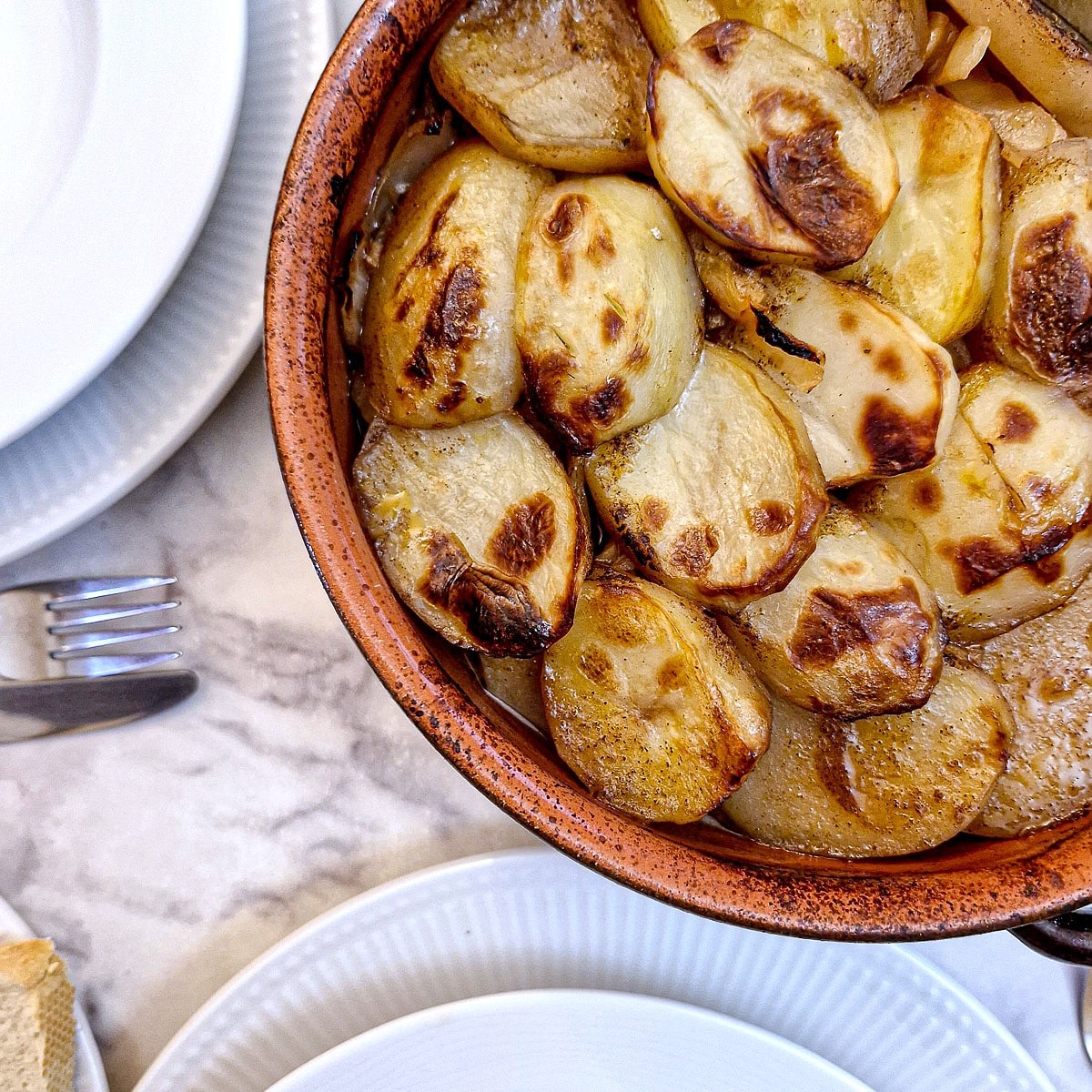
Step 15: Remove the lid (and the baking parchment/foil covering) for the final 20 minutes and turn the heat up to 200C/400F to allow the potatoes to brown.
The gravy
I need to say something about the gravy at this point.
The gravy is not thick gravy that you typically get by thickening cooking juices with cornflour or cornstarch. Instead, the gravy is more like a flavourful broth - packed with the juices from the vegetables and seasoned stock, and is perfect for soaking up with crusty bread.
If you would prefer a thicker gravy, stir a tablespoon of flour into the stock before you pour it into the potjie.
How to serve a lamb potjie
The best way to serve this potjiekos is straight from the potjie! Just put the pot on a trivet on the table and serve from there. Make sure each serving gets some of the lamb, a selection of vegetables, a few slices of the potatoes and plenty of gravy.
You won't need much to serve with it; my favourite is crusty bread, but if you want an even greater carb overload, you could serve it with a dish of plain white rice or mielie pap - which is a traditional South African maize porridge. You can find recipes for both krummelpap (which cooks to a coarse grainy texture similar to polenta) and stywepap (which is a thick, stodgy porridge and perfect for soaking up gravy) on the Cooksister web site.
For a fresh contrast, you could add a crisp green salad on the side, and of course, don't forget a dish of chutney and a bottle of Worcestershire sauce for those people who think it isn't sweet/savoury enough. (There's always that one person! )
Tips for a successful outcome
Here are my top tips to ensure your lamb potjie always turns out perfectly:
- Be sure to sear the meat. Coating the pieces of lamb in seasoned flour and browning them in a hot pan before adding them to the casserole dish might feel like an extra step, but it doesn't take all that long, and it adds loads of flavour to the stew.
- Fry the spices lightly for a few seconds to release their aromas, then deglaze the pan with red wine or beer. This ensures you pick up every last bit of flavour from the pan.
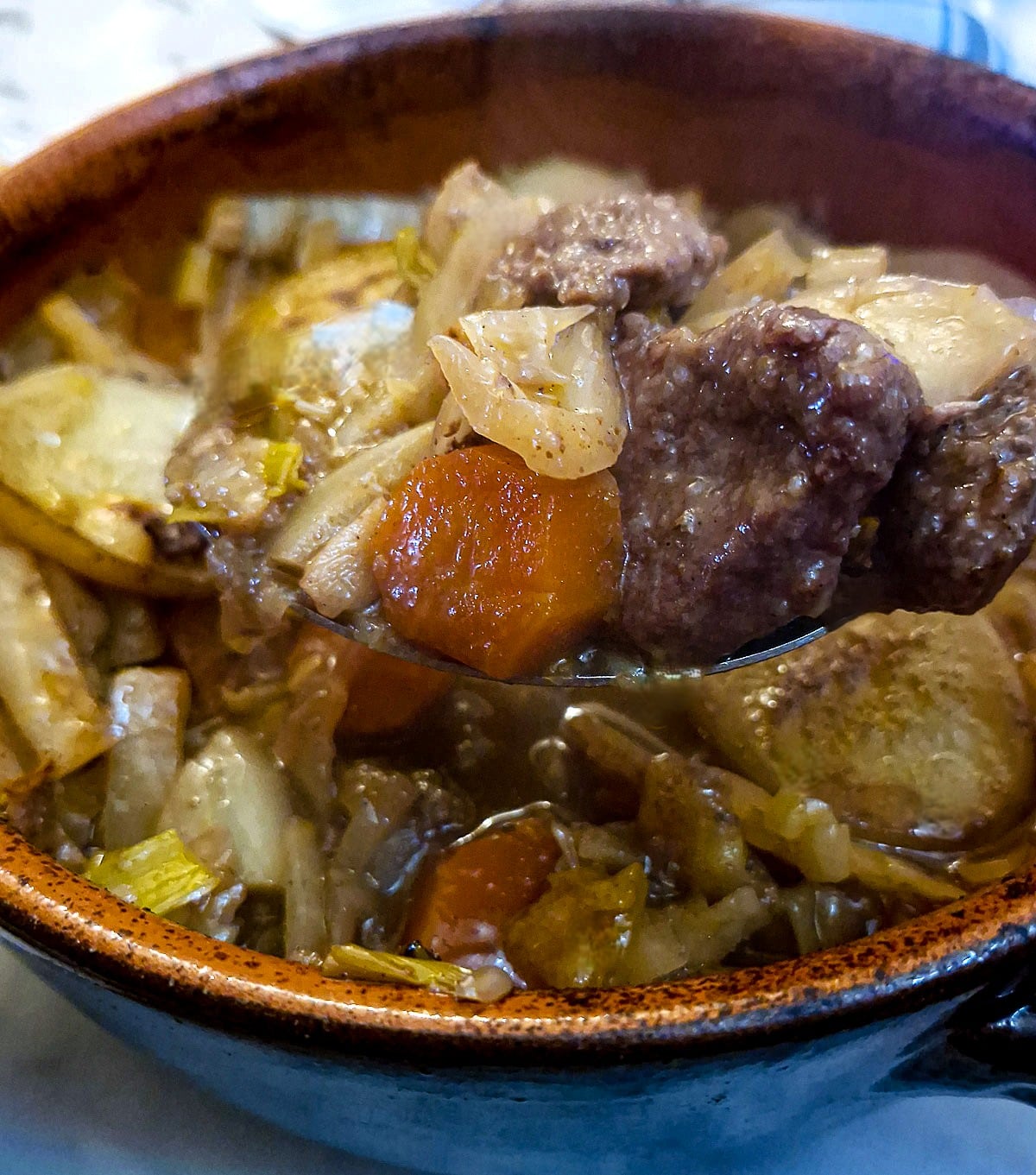
- Layer the vegetables over the meat. The traditional way of assembling a potjie is to keep the vegetables in layers rather than just tipping everything in. A proper potjie is assembled, covered with a lid, and left to cook on a low heat - it is never stirred! I've tried to replicate that in this recipe - the problem is that once you start to serve it, the layers tend to collapse and it all gets mixed together anyway 😁.
- Don't overseason. Because each layer of vegetables is seasoned (very lightly), it is easy to add too much seasoning (especially salt). You will probably need half to three-quarters of a teaspoon of salt for the entire dish - take care and season very lightly.
- Don't add too much liquid. I've allowed 2.5 cups of liquid (stock and red wine), but that might be too much. You want to pour in enough liquid to come about halfway up the dish - mine was just below the level of the potatoes. You can check halfway through the cooking time and top up with any remaining stock (or a splash of water) if necessary.
- Brown the potatoes. Because the potatoes are steamed in a closed casserole, they don't take on too much colour. I like to remove the lid for the final 20 minutes and crank up the heat a bit so the potatoes can get a nice golden brown colour. It doesn't do much for the taste (it's delicious either way), but it does give a more appetising appearance. Note - this is not part of the traditional outdoor open-fire cooking method.
Variations
The beauty of potjie-type cooking is that there are no hard and fast rules. You can chop and change to suit your own taste or ingredient availability. I'm sure I won't be contradicted if I say that every South African family has their own version of a potjie in one form or another!
Here are a few ideas for inspiration if you want to vary this lamb potjie (you could even mix and match them to suit your taste!):
- Tomato potjie. Add a tin of chopped tomatoes, and reduce the stock by one cup.
- Spicy. Leave out the apricots and add one or two chopped chillies (fry them with the onions), or add a teaspoon of dried chilli flakes.
- Extra fruity. Add extra chopped apricots, another tablespoon of chutney and a handful of sultanas or raisins. Swap the red wine for orange juice.
- Classic lamb. Leave out the chutney and the apricots and add extra garlic and a few sprigs of fresh rosemary.
- Extra veg - Add extra vegetables or swap in a few different ones. Green beans, butternut, sweet potatoes. You don't even have to worry about the softer veg such as butternut or zucchini (courgettes) disintegrating - it all adds to the flavour of the gravy! A favourite trick in South Africa was to arrange halved gem squash, (cut-side down) on top of the potatoes an hour before the potjie was ready.
Equipment
The most important thing for making a potjie in the oven is the choice of cooking vessel. A potjie needs a deep dish so you can arrange all the layers. It's the different juices coming out of the vegetables that create the tastiest potjie gravy. You need a deep casserole dish (at least 4 inches or 6 cm) and, if possible, with a tightly fitting lid. If the lid is a bit loose, you can improvise with baking parchment and tin foil to make a tight seal on the dish.
A flat, shallow dish isn't going to give you the same result!
This recipe tells you how to make a potjie without a potjie pot. However, if you'd like to know what a potjie looks like, here's an Amazon link to a traditional South African potjie.
Storage and freezing
Let's take a look at how we can store leftovers:
- Refrigerator. Cooled leftovers can be stored in a covered container in the refrigerator for up to 3 days.
- Freezer. This is a stew, and stews freeze beautifully! Transfer the cooled lamb stew into meal-sized containers and freeze for up to 3 months. Defrost in the refrigerator before reheating. My husband is a keen fisherman and often goes fishing overnight. He normally helps himself to a frozen meal from the freezer, pops it into his cooler box, and by suppertime, it's defrosted sufficiently for him to heat it on his camping stove!
- Reheating. Reheat the lamb stew in a saucepan on the stove until piping hot. You could also reheat it for 2 to 3 minutes in the microwave.
FAQ
The traditional way of making a potjie is to heat the cauldron over an open flame and brown the meat with onions in a little oil. Once that's done, a selection of vegetables is layered over the meat, with a layer of potatoes on top. Each layer is kept separate and lightly seasoned, and then stock is poured in, and the lid is placed on top.
The potjie is left to simmer for a few hours until done. The secret to a good potjie is to refrain from stirring it as it cooks; the layers should stay separate and distinct.
The coals should stay hot enough to allow the potjie to simmer - you don't want it to boil.
When we made this in South Africa, we used to have a second fire alongside, which we added coals to, and then used a shovel to top up the fire under the potjie as and when needed.
Yes, you certainly can - in fact, this is how a traditional lamb potjie is normally made, and you get tons of extra flavour from the bones. I used boneless lamb, so it didn't take quite so much space in the dish!
If using lamb pieces on the bone, I would advise adding an extra half hour to the cooking time. You will also need a larger dish to cook it in - bones take up quite a lot of space.
They are both pretty similar, and it all boils down to the way in which they are cooked.
In a traditional stew, everything is usually browned, combined and simmered together, often with enough liquid to cover the ingredients. It is stirred during cooking so the flavours blend evenly and the result is a soft cohesive dish where every spoonful tastes pretty much the same.
A potjie, on the other hand, is layered rather than mixed. The meat sits at the bottom, with the vegetables and potatoes layered on top, and only enough liquid to come partway up the dish. It's cooked slowly without stirring, allowing each ingredient to maintain its own taste and texture.
Yes, absolutely. That's what this post is all about. You need a deep, lidded casserole dish so you can assemble the layers. The key is to keep the heat low and to allow it to cook without stirring, just as you would with a traditional potjie.
No, absolutely not. This is one of the most important rules of potjie cooking. Once the ingredients have been layered in the pot, it should be left undisturbed while it cooks. Stirring will break up the layers and change the texture of the dish.
If you stir it, it becomes a stew rather than a potjie!
That's a very good question. Layering allows each ingredient to cook at its own pace. The meat cooks and tenderises in the juices at the bottom, the vegetables soften in the middle, and the potatoes steam on top, creating a dish with a lovely mix of textures.
- Get a good fire of hot coals (not fierce flames).
- Brown the meat and onions (I didn't brown the onions in the oven version)
- Add the wine and spices.
- Layer the vegetables according to the recipe.
- Add stock about halfway up the pot.
- Do not stir. Cover with a lid and leave for 2.5 to 3 hours.
- Add extra coals if needed and optionally place a few hot coals on the lid for more even cooking. Use a shovel to help you.
- Rest off the heat for 10 to 15 minutes before serving.
The real spirit of having a meal cooked in a potjie is not just the cooking, it's a slow, sociable occasion, where everyone sits around chatting, enjoying a drink and letting the pot do its thing.
There's something about a potjie over the coals that you just can't replicate indoors - the smell of the fire, the camaraderie, the 'is it ready yet?' questions, the whole vibe. It's something to be experienced!
Save for later
If you would like to try this lamb potjie, why not save the recipe to one of your Pinterest boards so you can find it easily? Just click the image below.
Alternatively, you can save the recipe by clicking on the floating heart icon on the right-hand side of the screen.
Related recipes
Visit my South African recipes page for other traditional South African recipes. Here are a few you might enjoy:
The recipe
Lamb potjie with apricots - cooked in the oven
(Click the stars to rate this recipe)
Equipment
- Large casserole dish with a lid at least 4 inches or 6 cm deep (deeper if possible to allow for arranging the layers of meat and vegetables).
- Sharp Knife
- Chopping Board
- Frying Pan to brown the lamb.
- Measuring jug to mix the stock
Ask a Question
If you have a question about this recipe that has not been answered, please use the box below to ask it.
Use this with care. This is an AI-generated result and may contain errors or inaccuracies. I cannot be held responsible for the information returned.
Ingredients
Lamb
- 1½ pounds / 700 grams boneless lamb leg or shoulder cut into chunks
- 3 tablespoons flour
- 1 teaspoon salt
- ½ tespoon black pepper
- 2 tablespoons vegetable oil
Vegetables
- 2 large onions peeled and sliced
- 1 large leek (white and green part) halved lengthwise, then sliced into semi-circles
- 3 cloves garlic crushed or finely sliced
- 3 large carrots peeled and cut into rings
- ¼ medium white cabbage roughly chopped
- 4 medium potatoes peeled and thickly sliced
Spices
- 2 teaspoons ground coriander
- 2 teaspoons ground cumin
- 1 teaspoon paprika smoked or sweet
- 1 teaspoon ground cinnamon
Stock and flavourings
- ½ cup / 120 ml beer or red wine your choice
- 2 cups / 480 ml chicken or vegetable stock make it with stock cubes
- 2 tablespoons Worcestershire sauce
- 2 tablespoons tomato puree/paste
- 2 tablespoons fruity chutney
- 10 dried apricots quartered
- Salt to taste
- Black pepper to taste
- 1 tablespooon / 10 grams flour optional (for a thicker gravy)
Instructions
Preparation
- Prepare the vegetables and leave them in a bowl of water until needed. Chop the garlic finely and leave it in a small bowl.
- Pat the lamb chunks with a paper towel to remove any excess moisture. Coat the lamb in flour seasoned with salt and pepper.1½ pounds / 700 grams boneless lamb leg or shoulder, 3 tablespoons flour, 1 teaspoon salt, ½ tespoon black pepper
Brown the lamb
- Heat the oil in a frying pan until it sizzles when you add a piece of coated lamb.2 tablespoons vegetable oil
- Fry the lamb for 2 to 3 minutes per side until nicely sealed and transfer it to your casserole dish. Leave any oil in the pan.
- Lower the heat and add the spices - stir for 60 seconds until fragrant. Add an extra splash of oil if necessary.2 teaspoons ground coriander, 2 teaspoons ground cumin, 1 teaspoon paprika, 1 teaspoon ground cinnamon
- Pour in the beer or red wine and simmer for 2 to 3 minutes, scraping up any browned bits from the pan.½ cup / 120 ml beer or red wine
- Pour the mixture over the lamb.
Assemble the potjie
- Layer the ingredients in this order, and season each layer very lightly with salt and black pepper.Onions, leeks and garlic / Carrots and apricots / Cabbage2 large onions, 1 large leek (white and green part), 3 cloves garlic, 3 large carrots, ¼ medium white cabbage, 10 dried apricots
- Arrange the sliced potatoes on top, overlapping them slightly (like fish scales). Season the potatoes lightly with salt and black pepper.4 medium potatoes
Add the stock
- Dissolve the stock cubes in 2 cups of boiling water, then stir in the Worcestershire sauce, tomato puree and chutney. Optionally, for a thicker gravy, allow the stock to cool, then stir in the flour. Don't stir flour into hot stock - it will just form lumps.2 cups / 480 ml chicken or vegetable stock, 2 tablespoons Worcestershire sauce, 2 tablespoons tomato puree/paste, 2 tablespoons fruity chutney, 1 tablespooon / 10 grams flour
- Pour in enough stock to come ¾ of the way up the ingredients (just below the potatoes). Reserve any excess stock in case you need to top up the potjie as it cooks.
Cook
- _Preheat the oven to 150°C /300°F (or fan 140°C / 285°F)
- Cover the dish with a lid and leave it to cook for 2 to 2½ hours. Check occasionally to see whether it is drying out - if so, top up with any remaining stock or add a splash of water. DO NOT STIR THE CASSEROLE.
- Remove the lid for the last 20 minutes and increase the oven temperature by 15°C or 30°F to allow the potatoes to take on a little colour.
- Remove from the oven and allow to rest for 15 minutes before serving.
Notes
- Be sure to sear the meat. Coating the pieces of lamb in seasoned flour and browning them in a hot pan before adding them to the casserole dish might feel like an extra step, but it doesn't take all that long, and it adds loads of flavour to the stew.
- Fry the spices lightly for a few seconds to release their aromas, then deglaze the pan with red wine or beer. This ensures you pick up every last bit of flavour from the pan.
- Layer the vegetables over the meat. The traditional way of assembling a potjie is to keep the vegetables in layers rather than just tipping everything in. A proper potjie is assembled, covered with a lid, and left to cook on a low heat - it is never stirred! I've tried to replicate that in this recipe - the problem is that once you start to serve it, the layers tend to collapse and it all gets mixed together anyway 😁.
- Don't overseason. Because each layer of vegetables is seasoned (very lightly), it is easy to add too much seasoning (especially salt). You will probably need half to three-quarters of a teaspoon of salt for the entire dish - take care and season very lightly.
- Don't add too much liquid. I've allowed 2.5 cups of liquid (stock and red wine), but that might be too much. You want to pour in enough liquid to come about half way up the dish - mine was just below the level of the potatoes. You can check halfway through the cooking time and top up with any remaining stock (or a splash of water) if necessary.
- Brown the potatoes. Because the potatoes are steamed in a closed casserole, they don't take on too much colour. I like to remove the lid for the final 20 minutes and crank up the heat a bit so the potatoes can get a nice golden brown colour. It doesn't do much for the taste (it's delicious either way), but it does give a more appetising appearance.
Nutrition
I am not a nutritionist. The nutrition information has been calculated using an on-line calculator, and is intended for information and guidance purposes only. If the nutrition information is important to you, you should consider calculating it yourself, using your preferred tool.
If you made this recipe and enjoyed it, I'd love it if you could give me a star rating in the comments below. And if you'd like to get in touch, you can email me at veronica@foodleclub.com. I'd love to hear from you. And don't forget to subscribe to my mailing list so you can grab yourself a copy of my FREE COOKBOOK!
If you'd like to continue browsing, just click on this link to all my recipes.

Cecilia D Morris says
I love this version, but I would also like to use my potjie pot while camping. How would I adjust the cooking time for over a fire?
VJ says
I did mention it in the FAQs in the post - but it was a long post so you might have missed it. Here are the instructions
- Get a good fire of hot coals (not fierce flames).
- Brown the meat and onions (I didn't brown the onions in the oven version)
- Add the wine and spices.
- Layer the vegetables according to the recipe.
- Add stock about halfway up the pot.
- Do not stir. Cover with a lid and leave for 2.5 to 3 hours.
- Add extra coals if needed and optionally place a few hot coals on the lid for more even cooking. Use a shovel to help you.
- Rest off the heat for 10 to 15 minutes before serving.
Chicken cooks quite quickly so there's not much difference in the cooking time provided you keep the coals nice and grey rather than flaming! However do check after 2 hours - it all depends on the heat of your coals.
Hope this helps x